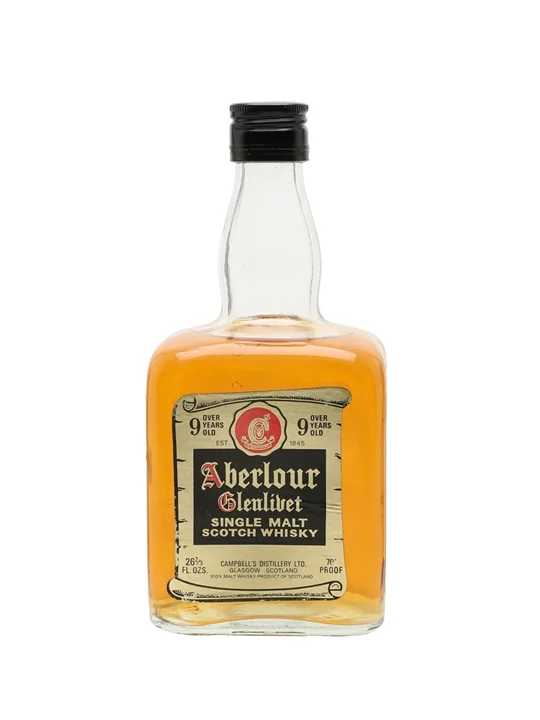

There are bottles that sit on a shelf and tell you everything about an era simply by existing. The Aberlour-Glenlivet 9 Year Old, bottled sometime in the 1970s, is one of those bottles. It comes from a period when Speyside distilleries were still routinely hyphenated with Glenlivet — a naming convention that spoke to regional pride rather than brand differentiation. Aberlour has always been a distillery I hold in high regard, and finding an expression from this era, at a relatively youthful nine years of age, is a genuine window into how the house character presented before decades of marketing repositioned it as a sherry-forward heavyweight.
At 40% ABV, this was bottled at the standard strength of its day. There is no cask strength theatre here, no limited-edition fanfare. This is simply Aberlour as it was — a working Speyside malt, nine years in wood, sent out into the world to be drunk. That honesty is part of its appeal. The 1970s bottling era means the spirit inside was almost certainly distilled in the 1960s, a decade when production methods across the Highlands still carried a certain handmade quality that is difficult to replicate in modern operations. Worm tub condensers were more common, malt was less uniformly processed, and the resulting spirit often carried a weight and character that rewarded even modest maturation periods.
At nine years old, this would have been a malt still showing plenty of distillery character — the raw DNA of Aberlour before extended cask influence smoothed everything into a single register. That is what makes younger vintage bottlings so instructive. You are tasting the distillate, not just the wood.
Tasting Notes
I will not fabricate specific tasting notes for a bottle of this age and rarity without a fresh sample in front of me. What I can say is that Aberlour's house style has long favoured a rich, slightly oily spirit with an affinity for both bourbon and sherry wood. A 1970s nine-year-old bottled at 40% would likely lean towards orchard fruit, a touch of malt sweetness, and that gentle waxy texture that characterises well-made Speyside spirit of the period. If the cask was kind — and bottlers of this era were generally good judges — there should be enough structure to reward close attention.
The Verdict
At £299, this is not an everyday purchase, but it is a surprisingly fair price for a 1970s single malt from a respected Speyside house. Comparable bottles from better-known distilleries routinely fetch two or three times that figure. What you are paying for here is provenance: a snapshot of Aberlour from a specific moment in its history, before the brand became synonymous with A'bunadh and double-cask finishes. For the collector who drinks their collection — and I firmly believe every bottle deserves to be opened — this represents genuine value. I am giving it an 8 out of 10, weighted towards the significance of what is in the glass and the integrity of what it represents. It is a piece of Speyside history at a price that has not yet caught up with the market.
Best Served
Neat, in a tulip-shaped nosing glass, at room temperature. If you have waited this long to open a bottle from the 1970s, you owe it the courtesy of tasting it without interference. A few drops of still water after the first pour, if you wish, but nothing more. This is a whisky that deserves your full attention.