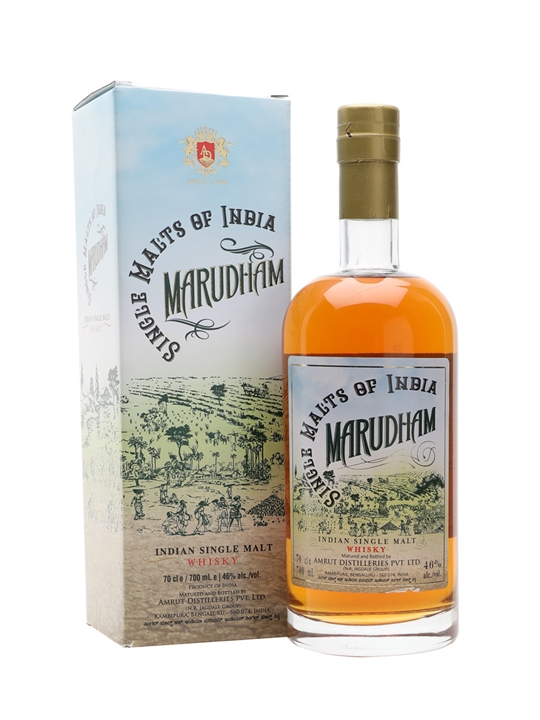

Amrut has, over the past two decades, done more to reshape the global conversation around single malt whisky than almost any distillery outside Scotland. Based in Bangalore, this Indian producer has consistently proved that tropical maturation — with its aggressive angel's share and rapid wood interaction — is not a limitation but a defining characteristic. The Marudham expression sits within their core range as a 46% ABV, non-age-statement single malt, and at £82.75 it occupies a price point that demands scrutiny.
What strikes me about the Marudham is its positioning. This is a whisky designed to showcase what Indian single malt does differently. The NAS designation is entirely appropriate here — Amrut's Bangalore climate means that a three-year-old whisky from their warehouses can carry the depth and wood influence you might associate with a far older Scotch. Judging this by Scottish age conventions would miss the point entirely. The 46% bottling strength, presented without chill filtration, is a welcome standard that allows the spirit's natural character to come through without compromise.
The name itself — Marudham — refers to agricultural lowland terrain in Tamil classical literature, a nod to the Indian terroir that shapes this whisky from grain to glass. It is this kind of cultural specificity that separates Amrut from producers content to simply imitate Highland or Speyside styles. They are making Indian whisky, and they want you to know it.
What to Expect
Without confirmed tasting notes to hand, I can speak to the broader Amrut house style and what this category of expression typically delivers. Amrut's single malts tend toward richness and intensity — tropical fruit, warm baking spices, and a malt sweetness that carries real weight on the palate. The 46% ABV should provide enough structure to support those characteristics without tipping into harshness. If you have tried Amrut's flagship single malt, expect the Marudham to sit in a similar register while offering its own distinct personality within the range.
The Verdict
At £82.75, the Marudham is not an impulse purchase, but it represents fair value within the context of quality single malt whisky in 2026. Comparable Scottish NAS expressions from well-regarded distilleries frequently exceed this price, and few of them offer the same sense of discovery. Amrut continues to earn its reputation through consistency and ambition, and this bottling is a confident entry in their lineup. I would score the Marudham at 7.6 out of 10 — a genuinely good whisky that rewards attention and demonstrates why Indian single malt deserves its place at the table. It loses a mark or two simply because, at this price, the competition from established Scottish and Japanese producers is fierce, and I would want to revisit it alongside those peers before pushing the score higher.
Best Served
Pour it neat at room temperature and give it five minutes to open up in the glass. If the intensity is too forthright, a few drops of water will soften the edges without drowning the character. This is not a whisky that needs ice or a mixer — let it speak for itself. A Glencairn glass is ideal, but any tulip-shaped vessel will do the job. If you are feeling adventurous, it should also work beautifully in a simple Highball with good soda water and a twist of orange peel — the malt sweetness typical of Amrut's house style tends to sing in that format.