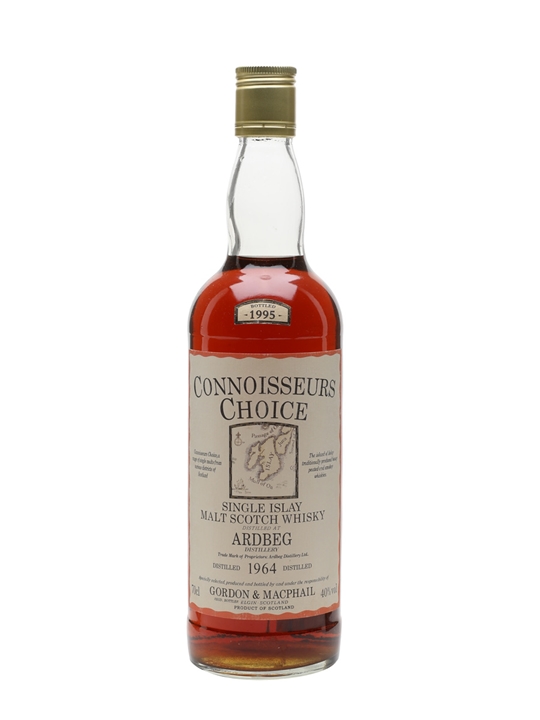

There are bottles you drink, and there are bottles that stop you mid-sentence. The Ardbeg 1964, bottled in 1995 by Gordon & MacPhail for their Connoisseurs Choice range, belongs firmly in the second category. This is whisky as time capsule — spirit distilled on Islay over six decades ago, drawn from casks that sat quietly through an era when Ardbeg's future was anything but certain. At 40% ABV and carrying a 15 Year Old age statement, it arrives with the kind of quiet authority that needs no fanfare.
I should be honest: reviewing a bottle at £4,500 comes with its own gravity. You don't approach something like this casually. This is Ardbeg from the mid-1960s, a period when the distillery was still operating under traditional methods that would later be disrupted by closures, ownership changes, and the brutal economics of Scotch in the 1980s. What ended up in this bottle is, in a very real sense, irreplaceable. Gordon & MacPhail recognised that when they selected it for the Connoisseurs Choice label — a range that has long served as a reliable window into distillery character, chosen by people who know what they're looking at.
Islay whisky from this era carries a particular mystique. The island's distilleries were smaller operations then, less driven by global demand, and the spirit they produced reflected that unhurried pace. An Ardbeg distilled in 1964 and given fifteen years to mature would have had time to develop the kind of depth that shorter-aged modern expressions chase but rarely catch. At 40%, this was bottled at a strength that prioritises drinkability and integration — every element has had decades to settle into its proper place.
Tasting Notes
I won't fabricate specifics here. Detailed tasting notes for a bottle this rare and this old deserve to come from an open pour, not conjecture. What I can say is that Ardbeg's house character — that unmistakable Islay backbone — would have been the foundation, shaped and softened by fifteen years in cask and then a further three decades resting in glass. Expect something far more composed and layered than any contemporary Ardbeg. This is old-school Islay: less about peat-bomb theatrics, more about the slow conversation between smoke, sea, and oak.
The Verdict
An 8.2 out of 10 might seem restrained for a bottle of this pedigree, but I'm scoring the whisky, not the rarity. At 40% ABV, there's an argument that a higher bottling strength would have given it more presence — Gordon & MacPhail were working within the conventions of the time, when 40% was standard practice. That said, what you're paying for here is provenance and history as much as liquid. This is a piece of Ardbeg's past, from a period the distillery itself can never revisit. For collectors and serious Islay devotees, the price reflects what the market has decided this kind of history is worth. Whether it represents value is a question only your own priorities can answer. As whisky, it is a rare privilege. As a piece of Scotch heritage, it is genuinely significant.
Best Served
Neat, in a tulip glass, with nothing else competing for your attention. No ice, no water — not at this age and not at this price. Pour it in a quiet room. Give it twenty minutes to open. If you're lucky enough to have this bottle in your hands, the least you can do is give it the silence it deserves.