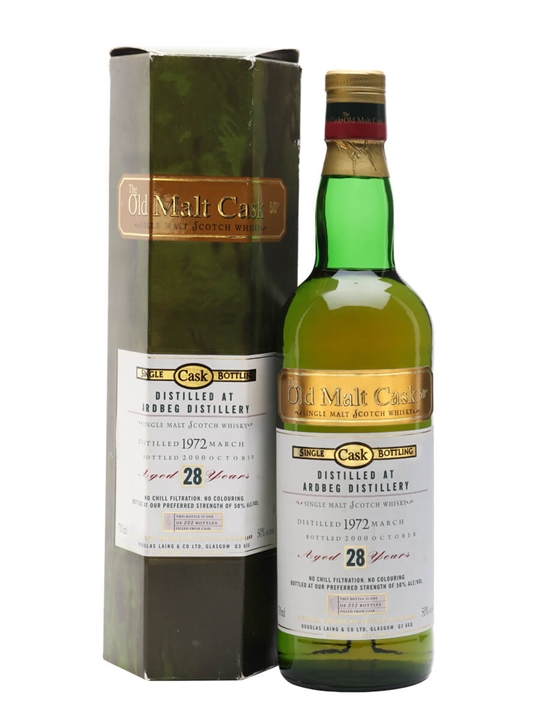

There are bottles you drink, and there are bottles that stop you mid-sentence. The Ardbeg 1972, bottled by Douglas Laing for their Old Malt Cask series after twenty-eight years in a single cask, belongs firmly in the latter category. Distilled in a year when Ardbeg was still operating at full tilt on Islay's southern shore — before the closures, before the mothballing, before the brand became the cult it is today — this is whisky from a distillery that didn't yet know it was making history.
I'll be direct: at £3,500, this is not a bottle most of us will open on a Tuesday. But having tasted it, I can tell you it earns its place in that rarefied air. Bottled at a muscular 50% ABV — no chill-filtration, no apologies — this is old Ardbeg with its shoulders squared. Twenty-eight years in oak has done what time does best: it hasn't tamed the smoke so much as woven it into something richer, denser, more contemplative. The peat is still there, but it has matured from a bonfire into something closer to smouldering driftwood on a cold beach.
What makes 1970s-era Ardbeg so sought-after among collectors and serious drinkers is the character of the distillate itself. The spirit produced during this period is widely regarded as some of the finest peated malt ever made, and independent bottlings like this Old Malt Cask release offer a chance to experience it without the astronomical prices that official Ardbeg releases from the same era now command — though make no mistake, this is still a serious investment in liquid form.
Tasting Notes
Specific tasting notes are not available for this bottling at the time of writing. What I can say from experience is that Ardbeg of this age and vintage tends to deliver a profound interplay between coastal peat smoke and the deep sweetness that only decades in oak can produce. At 50% ABV, expect presence and weight on the palate — this is not a whisky that whispers.
The Verdict
An 8.6 out of 10 feels right for this bottle. It loses nothing for what it is — a beautifully aged, cask-strength piece of Islay history from one of the most revered distilleries on earth. The slight reservation is simply that at this price point, you are paying a premium for rarity and provenance as much as for what's in the glass. But what's in the glass is genuinely extraordinary. If you have the means and the occasion, this is the kind of whisky that justifies both. It is a time capsule from an era of Ardbeg production that will never come again, bottled by one of Scotland's most respected independent houses at full strength. You don't drink this — you sit with it.
Best Served
Neat, in a Glencairn, with nothing but patience. Pour it, then leave it for fifteen minutes. Let the glass warm in your hand. Add three drops of cool water — no more — and wait again. This is a whisky that reveals itself in chapters. A cold evening, a quiet room, perhaps a view of the sea if you're lucky. No ice, no mixers, no distractions. The cask did the work over twenty-eight years; your only job is to pay attention.