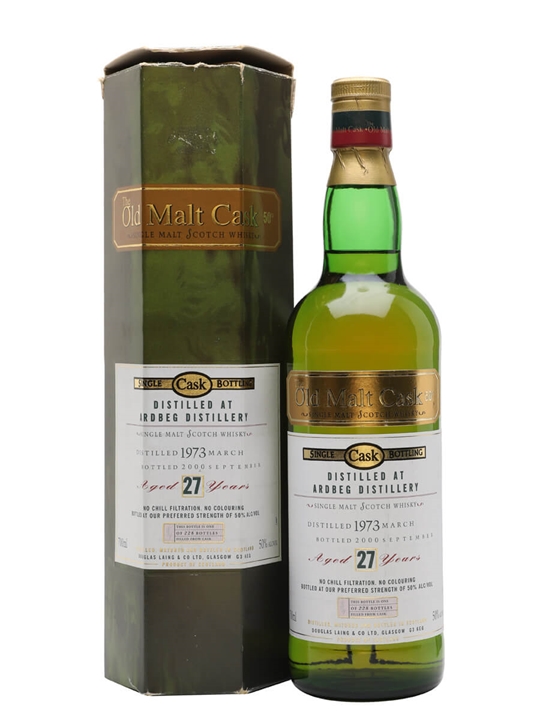

There are bottles you drink, and there are bottles that stop you mid-sentence. The Ardbeg 1973, bottled by Douglas Laing for their Old Malt Cask series after twenty-seven years in a single cask, belongs firmly in the second category. Distilled in a year when Ardbeg was still operating at full tilt on Islay's southern shore — before the closures, before the mothballing, before the uncertain decade that nearly killed the distillery — this is whisky from a vanished era, and it carries the weight of that history in every drop.
At 50% ABV, it arrives at what feels like a natural strength: muscular enough to hold its shape, restrained enough not to bully you. Douglas Laing's decision to bottle without chill-filtration, as is their way with the Old Malt Cask range, means nothing has been stripped out for cosmetic reasons. What you get is the unvarnished conversation between spirit and oak, carried on for nearly three decades.
What to Expect
This is old Ardbeg — and that distinction matters. The distillery's character in the early 1970s leaned into a peat profile that was dense, coastal, and uncompromising. Twenty-seven years of maturation will have softened those edges considerably, but with Islay peat of this vintage, you don't lose the smoke — it transforms. Expect something where maritime character and deep oak influence have merged into a single, layered thing. At this age and strength, the spirit will have absorbed serious complexity from the cask while retaining enough backbone to remind you where it was born. This is not a gentle dram. It is a thoughtful one.
The Old Malt Cask bottlings are single cask releases, which means this is a one-time expression. No blending, no vatting, no second chances. The whisky either worked or it didn't, and at twenty-seven years, you're trusting that the cask held its nerve. Given that Douglas Laing selected it for release, you can assume it did.
The Verdict
At £3,250, this is collector territory — there is no pretending otherwise. But this is not a bottle you buy to display. This is a bottle you buy because 1973 Ardbeg no longer exists in any meaningful quantity, and each remaining cask is a closed chapter of Islay's distilling story. The combination of vintage, age, natural strength, and single-cask integrity makes this a serious piece of whisky. I score it 8.7 out of 10 — a reflection of its rarity, its pedigree, and the sheer quality of what old Ardbeg becomes when it is left alone in good wood for long enough. It loses a fraction only because, without confirmed tasting notes from this specific cask, I am working partly on faith. But it is well-placed faith.
Best Served
Alone, late in the evening, in a room where nobody is going to interrupt you. A wide-bowled glass — a Glencairn if that is what you have, though something broader will let the nose open further at this age. Add nothing. No water, no ice, not yet. Let it sit for fifteen minutes after pouring. If, after your first sip, you feel it needs a few drops of water, add them sparingly. But give the whisky the courtesy of introducing itself on its own terms first. This is twenty-seven years of patience. The least you can do is offer it twenty-seven minutes of yours.