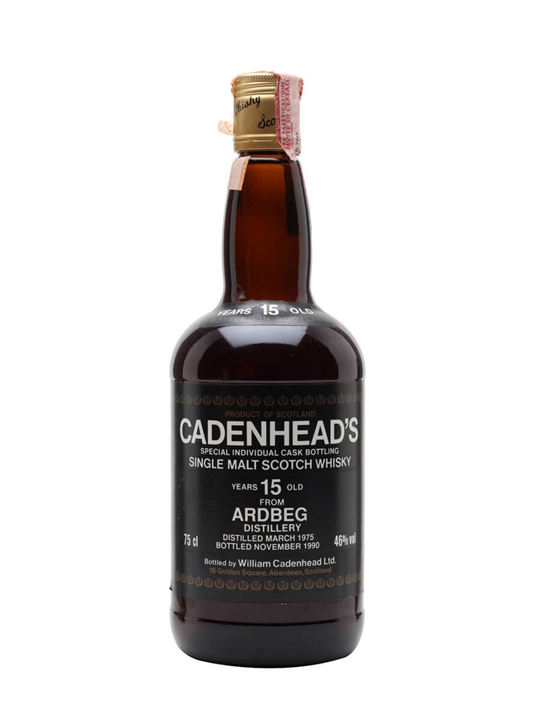

There are bottles you drink, and there are bottles that stop you mid-sentence. The Ardbeg 1975, bottled at 15 years old by Cadenhead's, belongs firmly in the second category. This is a whisky distilled during one of Ardbeg's most turbulent decades — the mid-seventies, when the distillery's future was anything but certain, when production was intermittent and every cask that survived feels like a small act of defiance against closure. To hold a bottle now, nearly half a century later, is to hold something that very nearly didn't exist at all.
Cadenhead's, Scotland's oldest independent bottler, had the good sense to pull this at 46% — no chill-filtration, no apologies. That's a bottling strength that lets an Islay malt of this age actually speak. Too many old Ardbegs get watered down to 40% and lose their nerve. Not this one. At fifteen years, the peat has had time to integrate without disappearing, and the coastal character that defines Ardbeg — that briny, smoke-laced intensity — should be woven through rather than sitting on top. This is the kind of whisky where the distillery's DNA isn't just present; it's the whole conversation.
Tasting Notes
I'll be honest: to describe this one in clinical tasting terms would be to miss the point. What I can tell you is what to expect from an Ardbeg of this era and age. The 1975 vintage sits in a window where the distillery was producing some of its most characterful spirit — raw, uncompromising Islay whisky shaped by traditional methods. At fifteen years in cask, you're looking at a whisky where smoke and oak have reached a kind of equilibrium, where the maritime influence of Islay's south coast has had time to leave its fingerprints. The 46% ABV promises texture and weight without burn. This is not a gentle dram. It's an Ardbeg, after all. But it's one that has earned its composure.
The Verdict
At £3,500, this is unambiguously a collector's bottle — and the market knows it. Ardbeg from the 1970s, independently bottled by Cadenhead's at a decent strength, is the kind of whisky that simply doesn't come around anymore. Every year, there are fewer of these left. Every year, the price climbs. But here's the thing: this isn't just a trophy. It's a genuine piece of Islay's history in liquid form, distilled during a period when the distillery was fighting for survival. The 8.2 I'm giving it reflects the remarkable provenance, the integrity of the bottling, and the sheer rarity of what's inside. If you're fortunate enough to find one, you're not just buying whisky. You're buying a chapter of a story that almost ended before it was written.
Best Served
Neat, in a thin-walled Glencairn, with nothing else competing for your attention. Pour it in a quiet room. Give it twenty minutes to open — a whisky this old and this rare deserves the patience. If you're on Islay itself, better still: let the salt air outside do what it does. A single drop of water if you must, but no more. This is not a whisky for cocktails, for mixing, or for showing off at parties. It's a whisky for sitting with, for thinking about where it came from and how unlikely it is that it ended up in your glass at all.