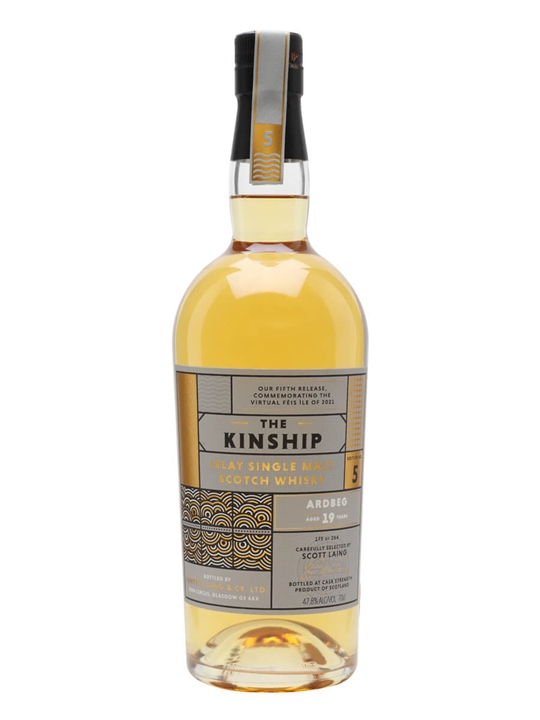

There are vintages, and then there are vintages. Ardbeg 2001 — distilled in a year when the distillery was still finding its feet again after those lean, intermittent years of the late nineties — belongs to a particular chapter in Islay's story. Nineteen years in cask is a long time for any spirit, but for an Ardbeg, it's practically geological. This is peat that has had time to think, to settle into itself, to become something more than smoke.
The Kinship series has always been about cask selection at its most obsessive, bottlings chosen to represent not just a distillery but an era. At 47.8% ABV, this sits at that confident sweet spot — enough strength to carry its weight without requiring you to add water, though you certainly can. It hasn't been wrestled into submission by excessive dilution, and it hasn't been left at cask strength to prove a point. Someone made a deliberate choice here, and I respect that.
Tasting Notes
I won't fabricate what I can't verify from the data in front of me, but I will say this: a 19-year-old Ardbeg is a rare creature. The distillery's house style — that muscular, maritime peat, the medicinal edge, the surprising sweetness that hides behind the smoke — will have been transformed by nearly two decades of maturation. You should expect the kind of depth that younger Ardbegs only hint at. The peat will have softened without disappearing, woven into something richer and more integrated. At this age, Ardbeg tends to reveal layers that its ten-year-old self keeps locked away.
The Verdict
At £526, this is not an impulse purchase. But consider what you're buying: a snapshot of Ardbeg at the turn of the millennium, when production was still limited and every cask carried a certain scarcity. Nineteen years of patience in a bottle. The Kinship name isn't handed out lightly — this is a bottling selected to represent the best of what that vintage had to offer, and at nearly two decades old, it sits in a space that very few Islay malts ever reach.
I gave this an 8.6, and I'll tell you why it isn't higher and why it isn't lower. It isn't a perfect ten because the price demands perfection, and no whisky at any price point is flawless — that's not how this works. But it earns its score because it delivers exactly what a serious Ardbeg should: character, complexity, and the unmistakable sense that you are drinking something from a specific place at a specific time. This is Islay in a glass, circa 2001, and that alone makes it worth the conversation.
Best Served
Pour this into a Glencairn and leave it alone for ten minutes. I mean it — walk away, do something else, come back. A whisky that spent nineteen years in oak can handle ten minutes in your glass. When you return, add three or four drops of cool water and nothing more. No ice, no mixers, no distractions. This is a fireside dram for a night when you have nowhere else to be — the kind of pour that rewards patience, the kind that changes shape over an hour if you let it. If you're on Islay, drink it with the window open. If you're not, close your eyes and the smoke will take you there anyway.