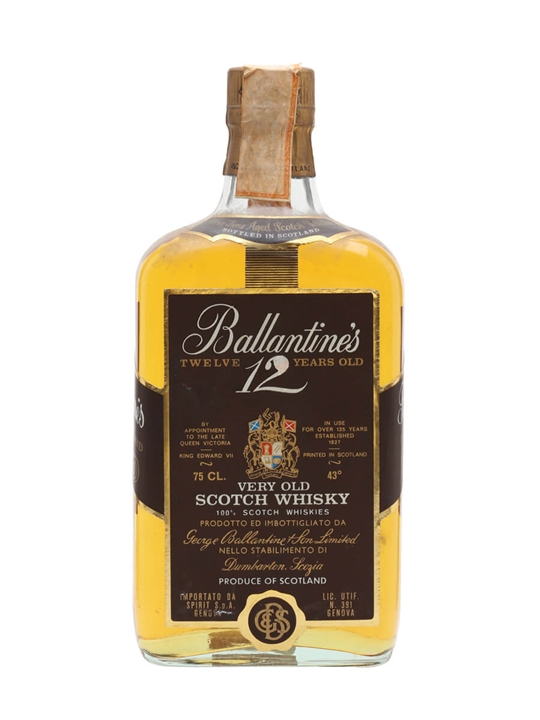

There's something quietly thrilling about holding a bottle that predates your career in whisky. This 1980s bottling of Ballantine's 12 Year Old is a time capsule from an era when blended Scotch still commanded genuine respect on the world stage — before single malts muscled their way to the front of every back bar and Instagram feed. At 43% ABV, it's bottled at a strength that tells you something about the standards of the period. Today's standard Ballantine's 12 sits at 40%. That three-percent difference isn't trivial.
For context, Ballantine's has always been a blender's brand. The 12 Year Old expression draws on a wide constellation of Speyside, Highland, and Islay malts married with quality grain whisky — the exact recipe a closely guarded thing, as with all serious blends. What matters here is that this bottle was filled during a period when the Scotch industry operated under different economic pressures. Overproduction in the late 1970s and early 1980s meant warehouses were brimming with mature stock. Blenders had the luxury of choosing from deep inventories. The whisky that went into blends during this window was, by many accounts, simply better resourced than what came after the closures and cutbacks of the mid-1980s.
At £135, this sits in interesting territory. You're paying a premium for provenance and scarcity — a sealed 1980s bottling in good condition isn't something you stumble across every week. But compared to the secondary market prices on vintage single malts from the same era, it's remarkably accessible. This is old-school blended Scotch at a price that still lets you actually open the bottle and drink it, which I'd strongly encourage.
Tasting Notes
I won't fabricate specific tasting notes from memory — what I will say is that 1980s Ballantine's 12 is widely regarded among collectors and whisky historians as a benchmark for what commercial blended Scotch could achieve when component stocks were plentiful and well-aged. Expect a richer, more rounded character than its modern equivalent. The 43% ABV gives it a firmness on the palate that the current 40% release simply cannot match. If you've ever wondered what all the fuss is about when old-timers talk about how blends used to taste, this is your education in a glass.
The Verdict
I'm giving this an 8.1 out of 10. That's a strong score for a blended Scotch, and I'm comfortable with it. This bottle represents a specific moment in Scotch whisky history — one where quality grain spirit, generous malt inclusion, and the 43% bottling strength combined to produce something genuinely worth seeking out. It's not the most complex whisky I've ever reviewed, but it's one of the most honest. It does exactly what a well-made 12-year-old blend should do, and it does it with a confidence that feels earned rather than marketed. The premium over a modern bottle is the cost of drinking history, and in this case, history tastes good.
Best Served
Pour it neat at room temperature and give it ten minutes to open up in the glass. If you're feeling sociable, a splash of still water — no more than a teaspoon — will coax out whatever the decades have done to the spirit. I'd avoid ice here. You don't chill a piece of history. Save the highballs for the modern expression. This one deserves a quiet evening, a comfortable chair, and the kind of attention that a forty-year-old blend has more than earned.