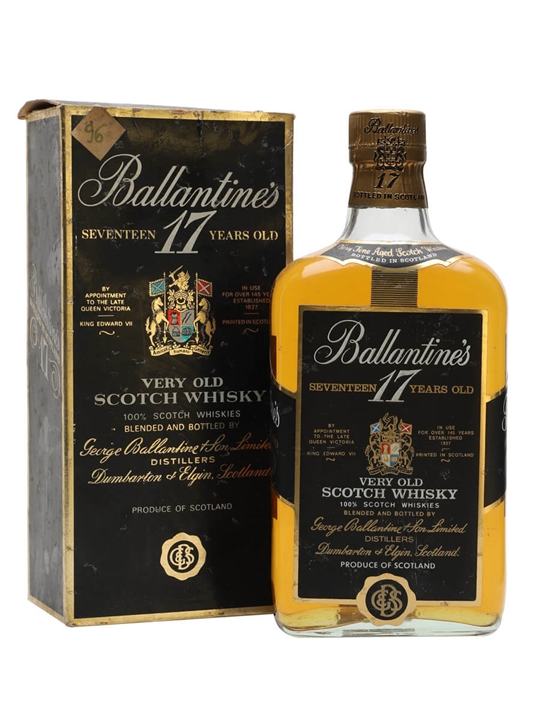

There's something genuinely thrilling about holding a bottle that predates your career, your mortgage, and most of your bad decisions. This 1970s bottling of Ballantine's 17 Year Old is one of those whiskies that forces you to reckon with just how good blended Scotch used to be — and, if we're being honest, how far some of the category has drifted since.
Ballantine's 17 has always been the quiet achiever in the blended world. While competitors chased flashy single malt releases and limited editions, Ballantine's built its reputation on consistency and complexity at the 17-year mark. This particular bottle, dating from the 1970s, represents the blend during what many industry watchers consider a golden period for Scotch production. Warehouse stocks were deep, grain whisky quality was high, and the blenders had extraordinary component malts to work with. At 43% ABV, it was bottled at a strength that actually lets the whisky speak — none of this watered-down 40% business that became standard later.
For context, the 1970s were a fascinating period for Ballantine's. The brand was already one of the top-selling Scotch whiskies globally, with particularly strong markets in Europe and Asia. The blending team had access to malt whisky from dozens of distilleries across Scotland, and the 17 Year Old expression sat at the prestige end of their range — old enough to carry real depth, young enough to retain backbone.
Tasting Notes
I won't fabricate specific notes for a whisky of this age and provenance — every bottle will have evolved differently depending on storage conditions over the past five decades. What I can say is that 1970s Ballantine's 17 is consistently spoken of in reverent terms by those who've had the privilege. Expect the hallmarks of classic blended Scotch at its peak: a balance between malt richness and grain smoothness that modern blends rarely achieve. At 43%, there should be enough weight to carry whatever complexity the years have developed.
The Verdict
At £399, this isn't an everyday purchase — but let's be realistic about what you're buying. This is a piece of Scotch whisky history, bottled during a period when blending was considered the highest art in the industry, not a poor relation to single malt. Compared to similarly aged single malt bottlings from the same era, which routinely fetch four figures at auction, £399 is actually reasonable. You're getting a 17-year-old whisky that was blended by craftspeople who had the pick of Scotland's warehouses, bottled at a proper strength, and left to mature further in glass for half a century.
I'm giving this an 8.3 out of 10. That score reflects both the quality of what Ballantine's 17 represented in this era and the reality that buying vintage blends always carries an element of uncertainty. If the bottle has been well stored — and at this price point, you'd hope the seller can confirm that — this should be a genuinely memorable dram. It's also a powerful argument for anyone who dismisses blended Scotch as somehow lesser. In the 1970s, this was the pinnacle. Treat it accordingly.
Best Served
Neat, at room temperature, in a proper tulip glass. Give it fifteen minutes after pouring before you go near it — a whisky that's been sealed for fifty-odd years deserves time to wake up. If you're feeling bold, a few drops of water might open things up, but start without. This is not a whisky for cocktails, ice, or showing off at parties. Pour it for someone who'll actually pay attention.