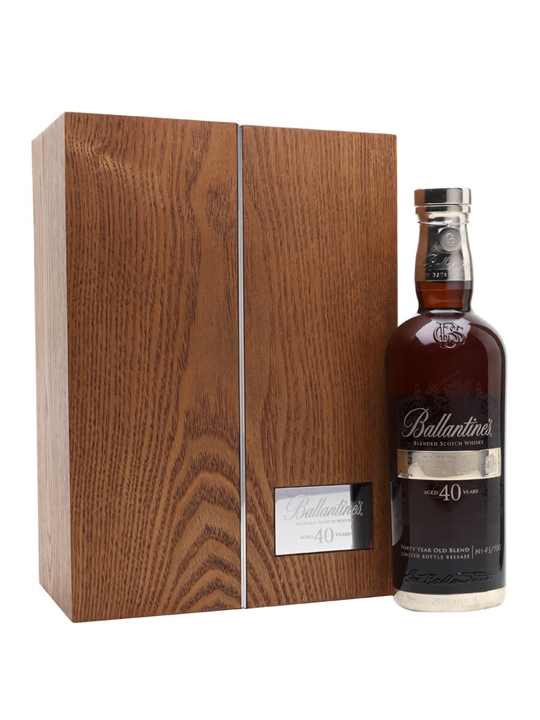

There are bottles that sit on a shelf and there are bottles that represent something closer to a thesis statement. Ballantine's 40 Year Old, the 2018 release, falls squarely into the latter category. At £7,200, this isn't a casual purchase — it's a declaration of intent, both from the buyer and from the blending team at Ballantine's, who have long operated as one of the most quietly competent houses in Scotch whisky.
Let me be direct: blended Scotch at this age and this price point occupies a strange position in the market. Single malts with four decades of maturation command similar figures without raising many eyebrows, but a blend? That demands a different kind of confidence. Ballantine's has earned that confidence. Their master blenders have historically had access to some of the finest casks across Speyside, Highland, and beyond, and a 40-year-old expression gives them the canvas to demonstrate what patient, considered blending actually means when the raw materials have had four decades to develop.
At 43% ABV, they've resisted the urge to bottle at cask strength — a deliberate choice that speaks to approachability. This isn't a whisky that wants to challenge you with heat or intensity. It wants to invite you in. The bottling strength suggests the blenders felt the spirit was already expressing everything it needed to at a more traditional proof, and with liquid this old, that restraint makes sense. Over-proofing a 40-year-old blend would be like shouting in a library.
Tasting Notes
I won't fabricate specific flavour descriptors I can't verify, but I can tell you what to expect from a blended Scotch of this age and calibre. Four decades of cask maturation will have drawn out deep, layered complexity — expect the kind of integration where individual components become impossible to separate. The grain whisky at this age will have developed a silky, almost waxy quality, while the malt components should bring depth and resonance. This is the beauty of old blends done well: they achieve a harmony that even the finest single malts sometimes can't replicate.
The Verdict
An 8.7 out of 10 feels right for this bottle, and I'll explain why it doesn't go higher despite the obvious quality. The whisky itself is, by all accounts, a masterclass in aged blending — Ballantine's at the peak of their craft. But £7,200 is a serious number, and even in the ultra-premium bracket, you're entitled to ask what separates this from other aged expressions at similar price points. What earns the 8.7 is the sheer audacity and skill of releasing a blended Scotch at this age and expecting it to stand alongside single malts twice its price. That takes conviction, and in my experience, Ballantine's has the blending pedigree to back it up. This is a collector's bottle, certainly, but it's also a drinker's bottle — and that distinction matters.
Best Served
Neat, in a tulip-shaped glass, at room temperature. Give it twenty minutes after pouring before you even think about nosing it properly. A whisky that's spent forty years in oak deserves at least that much of your patience. No water, no ice, no distractions. If you've spent £7,200, the least you can do is give it the room to speak. Pour small — 20ml is plenty. You'll want to come back to this over several sessions rather than drain it in one evening of enthusiasm.