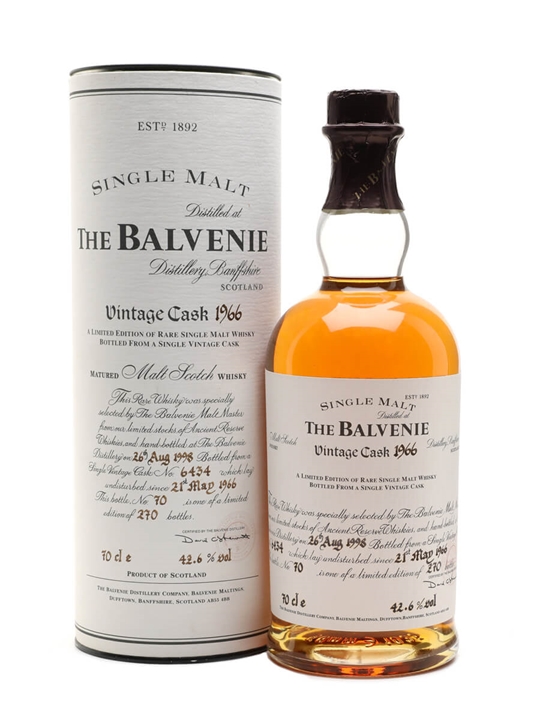
There are bottles you buy, and there are bottles that find you. The Balvenie 1966, a 32-year-old single cask release bearing the number 6434, belongs firmly in the latter category. Distilled in 1966 and left to mature for over three decades, this is a whisky that carries the weight of an era — one where Speyside distilling was defined by unhurried craft and long-term thinking. At 42.6% ABV, it has been bottled at a strength that suggests careful, natural maturation rather than aggressive intervention, and that restraint tells you a great deal about what is in the glass.
What to Expect
A 32-year-old Speyside from a single cask is, by its nature, an unrepeatable thing. Cask #6434 would have spent those decades in dialogue with the wood — at this age, you are tasting time as much as spirit. The 42.6% ABV sits just above the legal minimum, which for a whisky of this vintage typically means no chill-filtration was necessary, and what remains is concentrated, layered, and deeply expressive of its cask influence. Speyside malts of this generation tend towards a richness that more modern releases rarely achieve: the barley, the water, the slower rhythms of 1960s production all leave their mark.
This is not a whisky that shouts. At over three decades old, you should expect something considered and quietly complex — the kind of dram where you notice something different with every sip. The single cask designation means there is nowhere to hide; no vatting of dozens of barrels to smooth out rough edges. What you get is honest, singular, and irreplaceable. That is both the promise and the risk of single cask whisky, and at this age, the promise almost always wins.
The Verdict
I have to be straightforward: at £5,000, this is a bottle that demands serious consideration. But context matters. A 1966 vintage single cask Speyside of this age is genuinely rare — these casks are not being replaced, and each year there are fewer of them left. The 42.6% ABV gives me confidence that this was bottled with integrity, not padded out to maximise yield. For collectors and serious drinkers alike, a whisky like this represents something that the industry simply cannot produce anymore. The distilling conditions, the warehouse climate of that specific era, the particular oak of cask 6434 — none of it can be replicated.
At 8.6 out of 10, I am scoring this as a whisky that earns its price through rarity and pedigree. It is not a perfect ten because, frankly, I reserve that for bottles where every element — nose, palate, finish — reaches a level of transcendence that I can document in full detail. But as a piece of Speyside history bottled from a single cask, this is a remarkable release that any serious whisky enthusiast should experience if given the opportunity.
Best Served
Neat, and only neat. Pour it into a tulip-shaped nosing glass, let it sit for ten to fifteen minutes, and give it your full attention. A few drops of soft water — no more — if you feel the spirit needs to open after the first pour. This is not a whisky for cocktails, ice, or casual drinking. It is a whisky for a quiet evening when you have the time and the inclination to sit with something extraordinary. Treat the glass as the occasion it is.