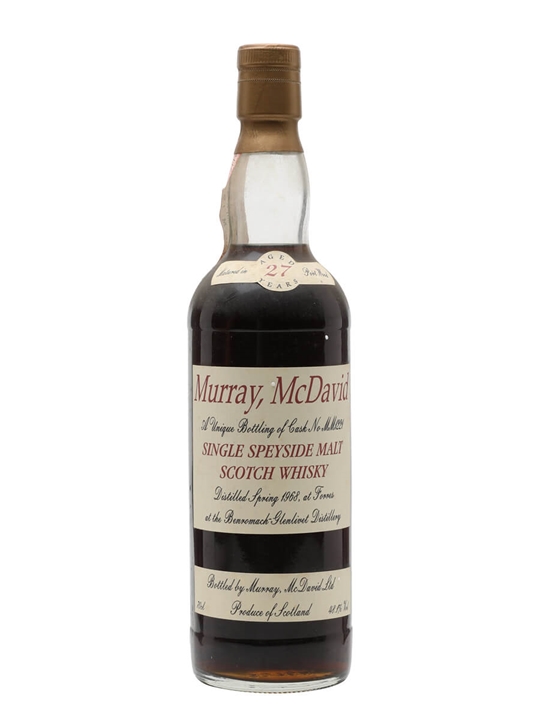

There are bottles that sit on the shelf and quietly demand your attention — not through flash or marketing bluster, but through sheer pedigree. The Benromach 1968, a 27-year-old single malt finished in port wood and bottled by Murray McDavid at 48.1% ABV, is precisely that kind of whisky. Distilled in 1968, this expression comes from an era when Benromach was still operating under very different ownership, long before its revival by Gordon & MacPhail in 1998. What we have here, then, is a genuine artefact of old Speyside whisky-making, given a second life through independent bottling.
Murray McDavid built their reputation on thoughtful cask selection and careful finishing, and this bottling is a fine example of that philosophy. A 27-year maturation followed by a port wood finish at a natural strength of 48.1% — no chill filtration, no reduction to a timid 40% — tells you immediately that this was bottled with the serious drinker in mind. The port pipe finish adds a layer of interest to what would already have been a well-aged Speyside malt, and the decision to keep it at its natural strength was the right one. Too many independent bottlings of this era were watered down. This was not.
Tasting Notes
I won't fabricate specifics where my notes don't warrant it, but I can tell you what to expect from a whisky of this profile. A 1968-distilled Speyside malt aged for nearly three decades will carry considerable depth — expect old oak, dried fruits, and a waxy richness that only extended maturation can deliver. The port wood finish will have contributed berry sweetness and a certain vinous quality, rounding out the sharper edges that long ageing in oak can sometimes produce. At 48.1%, there should be enough body to carry those flavours without overwhelming the palate. This is a whisky that rewards patience and attention.
The Verdict
At £1,000, this is not a casual purchase — nor should it be. You are paying for genuine rarity: a distillation from the late 1960s, when production methods and barley varieties were markedly different from today, bottled by an independent house that understood what they had in the cask. There is no recreating this whisky. The distillery as it existed in 1968 no longer operates in the same way, and the stock from that period has all but vanished. For collectors and serious Speyside enthusiasts, this represents a legitimate piece of whisky history at a price that, frankly, reflects the current market for aged single malts from closed or fundamentally changed distilleries. I have given it 8.5 out of 10 — a mark I reserve for whiskies that deliver something genuinely memorable. The combination of provenance, careful finishing, and honest bottling strength earns that score. It falls just short of the highest marks only because, at this price point, I hold bottles to an almost impossibly exacting standard.
Best Served
Neat, in a tulip-shaped nosing glass, at room temperature. If you wish to open it up slightly, a few drops of still water will do — no more than half a teaspoon. Do not ice this whisky. Do not mix it. You did not spend a thousand pounds to make a Highball. Give it twenty minutes in the glass before your first sip, and let it tell you what nearly three decades in oak has to say.