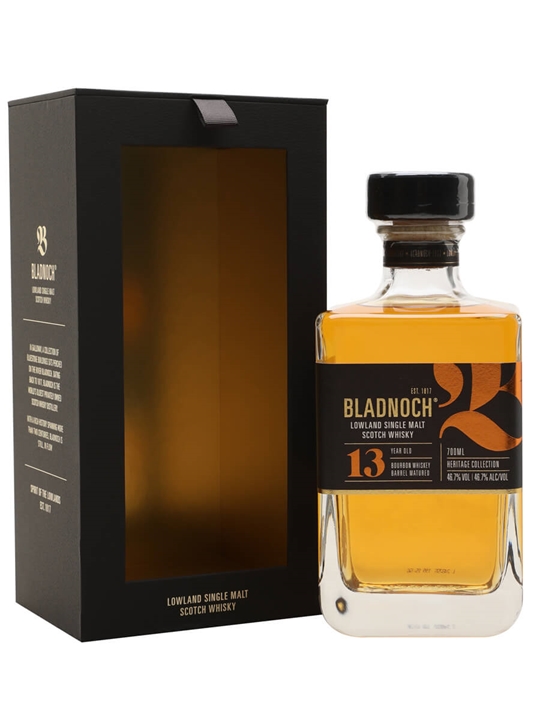
Lowland single malts have long occupied a quieter corner of the Scotch conversation, often overshadowed by the peat-heavy dramatics of Islay or the sherried richness of Speyside. That's always struck me as a missed opportunity. The Bladnoch 13 Year Old is precisely the sort of whisky that reminds you why the Lowlands deserve a seat at the table — and not just the one nearest the door.
At 46.7% ABV, this is bottled at a strength that signals confidence. It's above the industry-standard 40-43% minimum without veering into cask-strength territory, which tells me the producers wanted you to experience this whisky with some backbone intact. Thirteen years of maturation is a respectable stretch for a Lowland malt — long enough to develop genuine complexity, short enough to preserve the lighter, more floral character that defines the region's house style.
What to Expect
Without specific tasting notes to hand, I'll speak to what a well-made Lowland single malt of this age and strength typically delivers. The Lowlands are known for producing whiskies that are approachable, often grassy and gently sweet, with a clean, cereal-forward quality that rewards patience. At thirteen years, you'd expect the raw grain character to have softened considerably, giving way to more developed notes — think orchard fruit, gentle spice, perhaps a honeyed sweetness that lingers without cloying. The slightly elevated ABV should carry those flavours with real presence on the palate.
This is not a whisky that shouts at you. Lowland malts rarely do. Instead, they invite you to sit with them, to notice subtlety rather than spectacle. If you're the sort of drinker who finds pleasure in precision rather than power, this category has always had something to offer.
The Verdict
At £82.50, the Bladnoch 13 Year Old sits in competitive territory. You're paying for age, for a non-chill-filtered presentation at a natural strength, and for a style of whisky that remains genuinely underrepresented on most shelves. I've always believed that value in whisky isn't simply about the lowest price — it's about what the liquid gives you relative to what you've spent. By that measure, this performs well.
The 46.7% ABV is a detail worth highlighting again. It suggests a whisky that hasn't been diluted down to the lowest common denominator, and in my experience, that extra few percentage points of strength often translate directly into a more textured, more rewarding dram. I'd score this an 8.1 out of 10 — a genuinely good whisky that represents its region with quiet authority. It won't convert the peat fanatics overnight, but it isn't trying to. What it does, it does with real composure.
Best Served
Neat, at room temperature, in a tulip-shaped glass. If you find the 46.7% carries a little heat on first approach, add no more than a few drops of still water — just enough to open the nose without drowning what the years have built. This is a whisky designed for considered drinking, not cocktails. Give it the time it's earned.