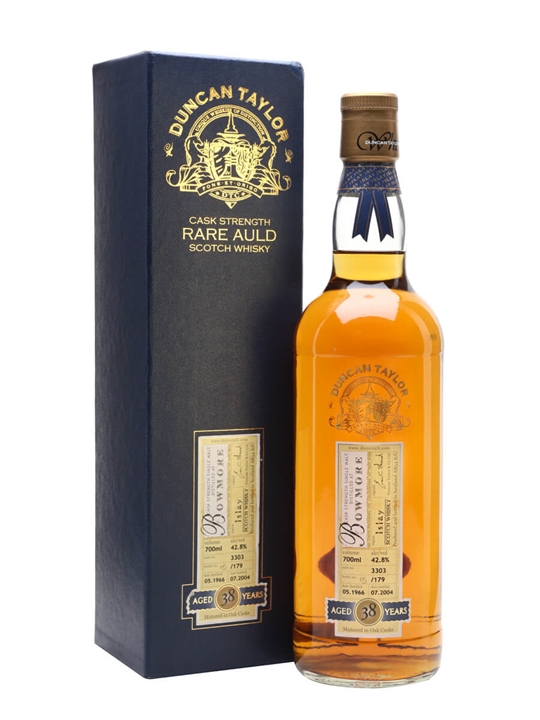

There are bottles you drink, and there are bottles that stop you mid-sentence. The Bowmore 1966, bottled by Duncan Taylor from cask #3303 after thirty-eight years of patient sleep, belongs firmly in the second category. This is whisky distilled in an era when Islay was still a quiet, wind-battered corner of Scotland known mainly to farmers and fishermen — long before the pilgrimages, the whisky festivals, the Instagram posts from Port Ellen's maltings. To hold a glass of something born in 1966 is to hold a small, amber window into a different world.
Duncan Taylor have long been among the most respected independent bottlers working with aged Islay stock, and cask #3303 is the kind of selection that justifies that reputation. Bottled at a natural 42.8% — no cask-strength bravado here, just the strength the wood and time agreed upon — this is a whisky that has clearly been watched over with care. Thirty-eight years in oak will break lesser spirits. It can strip away character, leave nothing but tannic wood and hollow vanilla. The fact that this Bowmore survived nearly four decades and emerged at a strength that still carries weight tells you something about the quality of the original distillate and the cask it was married to.
What to expect from a 1966 Bowmore of this age? The house style of that period leaned into a tropical, waxy character that has become legendary among collectors — a profile quite distinct from the more maritime, peat-forward Bowmore of recent decades. At 42.8%, this bottling invites patience. It is not a whisky that shouts. It will unfold slowly, each sip revealing layers that only deep maturation can produce. The peat, if present at all after thirty-eight years, will have softened into something atmospheric rather than assertive — more hearth smoke than bonfire.
Tasting Notes
Detailed tasting notes are not available for this particular bottling. Given its provenance and age, this is a whisky best approached without expectations — let the glass tell its own story.
The Verdict
At £7,500, this is not a bottle you buy on impulse. It is an investment in experience — the kind of dram that marks an occasion, a milestone, a moment worth remembering. Is it worth the price? That depends entirely on what you value. If you are looking for bang-for-pound peat, buy an Ardbeg. If you are looking for a piece of Islay's history in liquid form, distilled in the same year England won the World Cup and bottled with the kind of restraint that only confidence allows, then cask #3303 earns its place. I score it 8.1 out of 10 — a remarkable survivor, a whisky of quiet authority, docked only slightly because bottles at this price point must compete with the very greatest old Islays ever released, and that is fierce company indeed.
Best Served
Neat, in a thin-lipped tulip glass, with nothing but time and silence for company. Add a few drops of cool, soft water if you wish — at 42.8% it does not demand it, but water may coax out dimensions that decades in oak have tucked away. Do not chill it. Do not rush it. Pour a small measure, sit somewhere without distractions, and give this whisky the evening it deserves. A dram like this has waited thirty-eight years for you. The least you can do is wait for it.