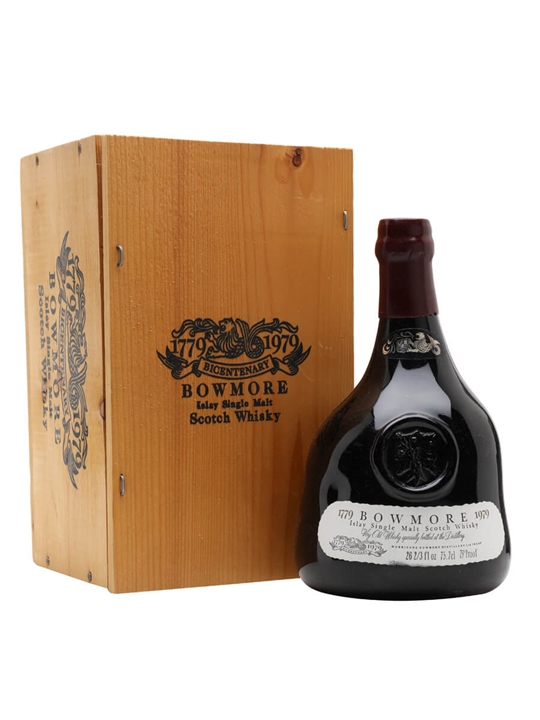

There are bottles you review, and there are bottles that carry the weight of history in every detail — from the label design to the liquid itself. The Bowmore Bicentenary, bottled in 1979, falls firmly into the latter category. Bearing the name of Islay's oldest distillery and released to mark what would have been two centuries of production on the shores of Loch Indaal, this is a single malt that commands attention long before you pull the cork.
I should note upfront that the distillery attribution on this particular bottle remains unconfirmed through independent verification, which is not unusual for releases of this vintage. The label states Bowmore, the occasion references the distillery's bicentenary, and the provenance is consistent — but in the world of collectible whisky, precision matters, and I want to be transparent about that. What I can speak to with confidence is what's in the glass.
At 43% ABV, this is bottled at a strength that was standard for its era — no cask strength theatrics, no attempt to overpower. It's a whisky that reflects a time when Islay malts were built to drink, not to speculate on. The NAS designation is largely irrelevant here; age statements on bottles from this period often told you less than the liquid itself, and a 1979 bottling from an Islay distillery would have drawn from stock laid down in the 1960s or earlier, when production methods and ingredient sourcing were markedly different from today.
What to Expect
Without specific tasting notes to hand, I can speak to the style with some authority. Islay single malts from this period — particularly those associated with Bowmore — tend to sit in a register that modern drinkers may find surprisingly gentle. The heavy peat-forward profile that dominates today's Islay conversation was less pronounced in many distillery outputs of the 1960s and 1970s. You should expect a whisky with maritime character, certainly, but one where fruit, floral complexity, and a certain waxy elegance are likely to share the stage with smoke rather than be buried under it.
The Verdict
At £6,000, this is unquestionably a collector's bottle, and I score it 7.7 out of 10. That is a strong rating from me, and here's why: the historical significance is genuine, the era of production is one that consistently delivered extraordinary Islay malt, and the bottle itself represents a moment in Scotch whisky that cannot be replicated. Where I hold back slightly is on the unconfirmed distillery attribution — for a bottle at this price point, certainty matters, and a buyer deserves to know exactly what they're acquiring. That said, if the provenance checks out, this is a piece of whisky history that rewards the serious collector and the serious drinker in equal measure.
Best Served
If you are fortunate enough to open this bottle, serve it neat in a tulip glass at room temperature. Give it fifteen minutes to breathe after pouring — a whisky of this age and vintage will evolve considerably in the glass. A few drops of soft water may open it further, but I would resist the temptation to add anything else. This is a dram that deserves your full, undivided attention. No ice, no mixers, no distractions.