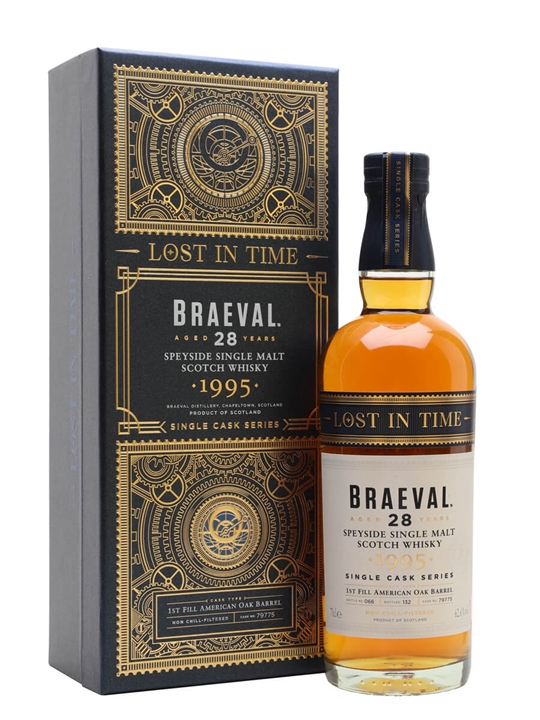
Braeval is one of those distilleries that commands respect among serious whisky enthusiasts while remaining largely invisible to the casual drinker. Built in 1973 as Braes of Glenlivet and renamed in 1994, it has spent most of its working life as a component malt for blends — which means independently bottled single casks like this one are genuinely rare finds. When a 28-year-old cask surfaces from a distillery with this profile, you pay attention.
This particular bottling, Cask 79775, comes from the Lost In Time series and was distilled in 1995. At 62.6% ABV and natural cask strength, it has clearly been left to mature without interference — no chill filtration, no dilution, just time and oak doing their work over nearly three decades. That kind of patience is increasingly uncommon in an industry racing to meet demand, and it shows in the result.
A 28-year-old Speyside single malt at cask strength is a statement. Braeval's spirit character tends toward the lighter, more fragrant end of the Speyside spectrum — think orchard fruit and gentle cereal sweetness rather than heavy sherry influence. Nearly three decades in oak will have added considerable depth and complexity to that foundation, layering in the kind of dried fruit, spice, and mature wood character that only real age can deliver. At 62.6%, expect this to open up substantially with water, revealing layers that reward a slow, considered approach.
Tasting Notes
I would encourage anyone fortunate enough to acquire a bottle to take their time with this one. At this ABV, adding water in careful stages will unlock different dimensions of the whisky — it is the kind of dram that changes character over the course of an evening. Tasting notes will follow in a future update once I have had the opportunity to sit with this properly over multiple sessions, which a whisky of this calibre deserves.
The Verdict
At £535, this is not an impulse purchase — nor should it be. But context matters here. Independent bottlings of Braeval at this age are scarce, and they are not getting more common. The distillery's output largely disappears into blends, so a single cask at 28 years old represents something genuinely uncommon. You are paying for rarity, for cask strength integrity, and for the simple fact that someone had the good sense to leave this cask alone for nearly three decades.
I am giving this an 8.6 out of 10. The combination of distillery scarcity, genuine age, and uncompromised cask strength bottling makes this a compelling proposition for collectors and serious drinkers alike. It loses a fraction simply because Braeval, for all its quiet quality, does not carry the immediate name recognition that might justify the price to less experienced buyers. But for those who know what they are looking at, this is exactly the kind of bottle worth seeking out.
Best Served
Neat, in a tulip-shaped nosing glass, with a few drops of room-temperature water added gradually. At 62.6% ABV, this whisky demands water — not to tame it, but to let it speak. Start with a small measure undiluted to appreciate the full cask strength intensity, then add water drop by drop and watch it transform. This is an evening dram, best enjoyed without distraction and with enough time to let the glass evolve. A Glencairn or copita will serve you well here.