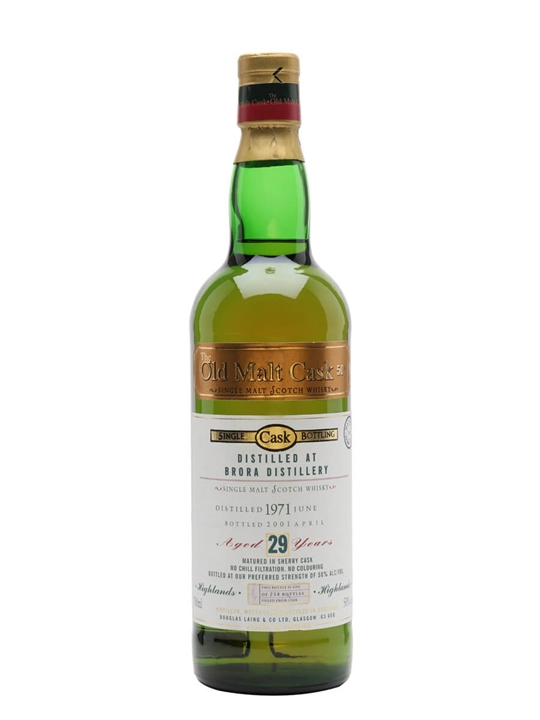
There are certain bottles that carry the weight of history before you even draw the cork. This Brora 1971, bottled under Douglas Laing's Old Malt Cask series at 29 years of age, is one of them. Distilled at a Highland distillery that shuttered its doors in 1983, every remaining cask from Brora's original era is a finite resource — and at nearly three decades in sherry wood, this particular expression has had a long time to become something extraordinary.
A 1971 vintage places this squarely in the era when Brora was producing whisky with that distinctive waxy, sometimes lightly peated character that has made it one of the most sought-after names in Scotch. Bottled at a natural 50% ABV with no chill-filtration — as is Douglas Laing's standard practice with the Old Malt Cask range — this is whisky presented honestly, without cosmetic interference. That matters. At this age and from this distillery, you want every molecule of flavour the cask has to offer.
Twenty-nine years in sherry wood is a serious commitment. For context, most sherry-matured Highland malts reach the market between 12 and 18 years. Pushing past a quarter century risks the wood overwhelming the spirit, but Brora has always been a distillate with enough backbone to stand up to extended maturation. The 50% strength confirms this wasn't a cask that faded — it retained its power across those decades, which speaks to good warehousing and a well-chosen butt.
What to Expect
Without sherry-cask Brora of this vintage, you're in territory that typically delivers dried fruit richness, old leather, beeswax, and a depth that younger whiskies simply cannot replicate. The Old Malt Cask series favours single-cask bottlings, meaning this is the product of one specific sherry cask's interaction with one specific parcel of Brora spirit over 29 years. No blending, no averaging — just the singular result of time and oak.
At £6,000, this is obviously not a casual purchase. But within the context of vintage Brora pricing — where bottles regularly command five figures at auction — this sits at a point where serious collectors and serious drinkers can still justify opening it rather than simply displaying it. And it should be opened. Whisky exists to be drunk.
The Verdict
I give this an 8.5 out of 10. That score reflects genuine quality and historical significance, tempered by the reality that at this price point, I hold bottles to an exacting standard. This is a rare, well-preserved example of a distillery that no longer produces whisky from this era, bottled by an independent house with a strong reputation for cask selection. It earns its place among the most collectible Highland malts I've encountered, and more importantly, it earns its place in a glass. The combination of vintage, cask type, natural strength, and provenance is compelling. If you have the means and the opportunity, this is a bottle worth securing.
Best Served
Neat, in a tulip-shaped nosing glass, at room temperature. Give it ten minutes to open after pouring — a whisky of this age and concentration will evolve considerably in the glass. If you find the 50% ABV needs tempering, add no more than a few drops of still water. A whisky that has spent 29 years developing complexity deserves the patience to let it speak on its own terms. No ice, no mixers — this is not a Highball whisky. This is a chair-by-the-fire whisky.