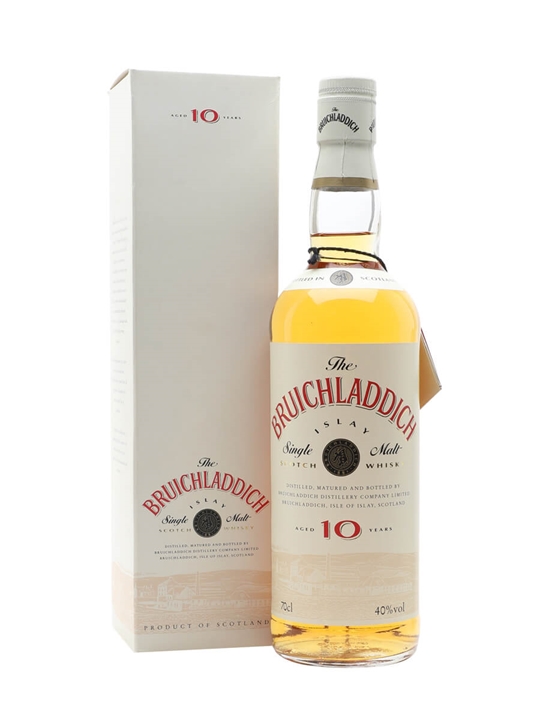

There are bottles you drink, and there are bottles that tell you something about where whisky has been. This Bruichladdich 10 Year Old, bottled sometime in the 1990s, falls squarely into the latter category. It arrives from a period when the Islay distillery was under different stewardship, before its revival in 2001 under Mark Reynier and Jim McEwan — a chapter that reshaped everything we now associate with the name. To hold a bottle from the preceding era is to taste a different philosophy entirely.
Bruichladdich has always been something of an outlier on Islay. Situated on the western shores of Loch Indaal, it was historically the least peated of the island's distilleries, favouring a more delicate, floral approach to single malt. A 10-year-old expression from this period, bottled at the standard 40% ABV, would have been positioned as an accessible entry point — though "accessible" hardly describes the asking price today. At £225, you are paying for scarcity and provenance rather than cask strength or extreme age. That is the reality of discontinued bottlings from a distillery that has since become one of the most talked-about names in Scotch.
Tasting Notes
I will not fabricate specifics where my notes would be speculation. What I can say with confidence is that Bruichladdich from this era was typically characterised by a lighter, more maritime style — saline, subtly fruity, with a gentle cereal sweetness that distinguished it from its heavier Islay neighbours. At 40% and ten years of maturation, expect something restrained rather than bombastic. This is not a peat monster. It is a whisky that rewards patience and attention, asking you to meet it on its own quiet terms.
The Verdict
I gave this an 8.3 out of 10, and I want to be clear about why. This is not a score driven by raw power or complexity — at 40% ABV and a decade of age, it was never intended to be a heavyweight. What earns the mark is historical significance and the quality of what Bruichladdich was producing in this period: honest, well-made Islay malt that did not rely on peat smoke as a crutch. It is a window into a distillery before its reinvention, and that context adds genuine depth to the drinking experience. The price is steep, certainly. But for collectors and students of Islay whisky, this is a meaningful bottle. It documents a style that no longer exists in quite this form, and there is real value in that — provided you understand what you are buying.
Best Served
Neat, at room temperature, with perhaps five drops of still water if you find the initial pour closed off. A bottle of this age and scarcity deserves unhurried attention. Pour it into a tulip-shaped nosing glass, give it ten minutes to open, and drink it slowly. This is not a whisky for mixing or casual evening pours — it is one to sit with, preferably alongside someone who appreciates what a 1990s Islay bottling represents.