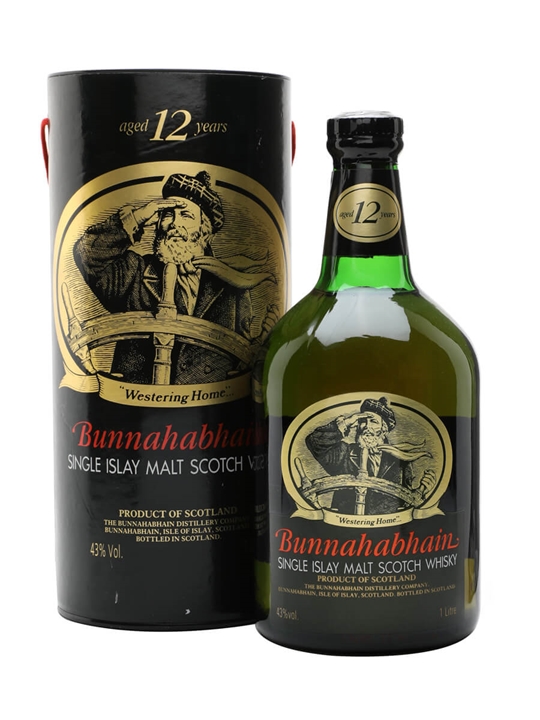
There are bottles you drink, and there are bottles that stop you mid-pour and make you wonder where they've been. This 1990s bottling of Bunnahabhain 12 Year Old — a full litre, no less — belongs firmly in the second category. It arrived on my desk without fanfare, just a quiet presence that said more about a particular moment in Islay's history than any marketing campaign ever could.
Bunnahabhain has always been the gentle contrarian of Islay. While its neighbours along the southern coast blast you with peat smoke and maritime iodine, Bunnahabhain sits up on the northeast shore, looking out across the Sound of Jura, doing its own thing. The distillery has long favoured an unpeated style — or at most, lightly peated — which makes it the island's most approachable single malt and, paradoxically, one of its most misunderstood. People expect Islay to punch them in the mouth. Bunnahabhain offers a handshake instead.
This particular bottle dates from the 1990s, a period when Bunnahabhain 12 was bottled at 40% as standard across most markets. At 43% ABV in a litre format, this feels like it was intended for travel retail or a specific export market — bottles like these often carried a little more weight and character than their domestic counterparts. The higher strength is a welcome detail. Those three extra percentage points don't sound like much on paper, but in the glass they tend to hold the whisky's structure together with more conviction.
At twelve years old and bottled over three decades ago, what you're really buying here is a time capsule. The spirit inside was distilled sometime in the early-to-mid 1980s, when production methods, barley varieties, and cask sourcing were all subtly different from today. That era of Bunnahabhain is well regarded among collectors and drinkers who've had the good fortune to try it. The distillery's house style — coastal but not briny, nutty, gently honeyed, with a clean malt backbone — tends to show beautifully at this age, old enough to have developed complexity but young enough to retain energy.
Tasting Notes
I won't fabricate specific tasting notes from memory where precision matters. What I will say is this: expect the classic Bunnahabhain profile dialled up by age and era. Think gentle sea air rather than crashing waves, orchard fruit rather than tropical excess, and a malty sweetness grounded by something slightly savoury. The 43% ABV should give it enough presence to reward patience without needing water, though a few drops certainly won't hurt.
The Verdict
At £325, this is not an everyday bottle — but it was never meant to be. You're paying for provenance, rarity, and a snapshot of Islay whisky-making from an era that's gone and isn't coming back. For collectors of old Bunnahabhain, this is a fair price in today's market, where far younger bottles from fashionable distilleries command similar figures with a fraction of the character. Is it worth it? If you care about what Islay tastes like when it isn't trying to impress you — when it's simply being itself — then yes. I'd score this 8.3 out of 10: a confident, well-made whisky with genuine historical interest, docked only slightly because the proof of the pudding is always in the drinking, and bottles of this age can vary.
Best Served
Pour it neat into a Glencairn, let it sit for five minutes, and give it your full attention. This is a rainy Sunday afternoon dram — no distractions, no music, just you and the glass and whatever the 1980s left behind in that bottle. If you're feeling generous, share it with someone who thinks all Islay whisky tastes like a bonfire. Watch their face change.