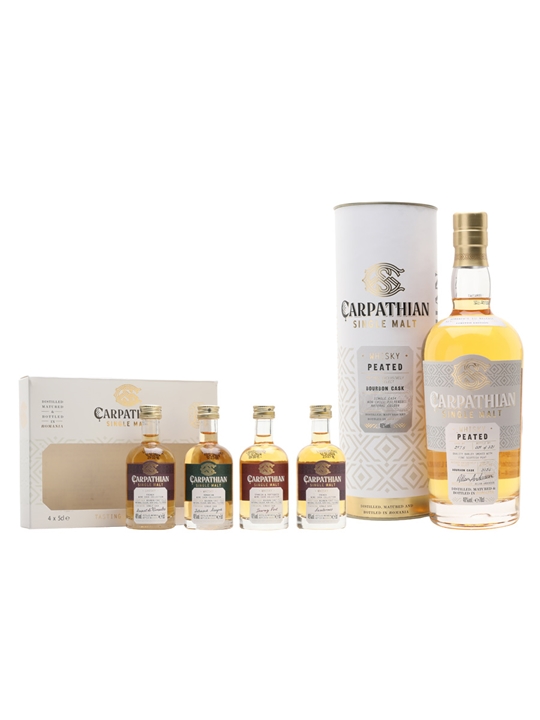

I'll admit it — when a 30-year-old single malt lands on my desk at under £51, my first instinct is scepticism. Three decades in wood is serious time, and serious time usually commands serious money. The Carpathian Peated Bourbon Cask Single Malt challenges that assumption head-on, and having spent a week with this bottle, I'm convinced it deserves your attention.
This is a single malt from the Carpathian region — a corner of the whisky world that remains largely under the radar for most drinkers. The specification alone tells you someone has made deliberate choices here: peated malt, bourbon cask maturation, bottled at 46% ABV without chill filtration (a strength that suggests confidence in the liquid). At 30 years old, this whisky has had the kind of extended conversation with oak that most distillers can only dream of offering at this price point.
Style and Character
What you're dealing with is a fascinating intersection of influences. Peat and bourbon cask is a combination I know well from Islay and parts of the Highlands, but in a Carpathian context it takes on a different dimension. Thirty years of maturation will have softened whatever peat character was laid down at distillation — expect integration rather than aggression. The bourbon cask influence over that length of time should contribute depth of vanilla, dried fruit, and honeyed sweetness, all woven through with that smoky backbone. At 46%, you're getting enough strength to carry the complexity without needing to add water, though a few drops will open up a whisky of this age beautifully.
This is not a whisky that needs to shout. The age alone tells you it will have developed layers of character that reveal themselves slowly. Think of it as a contemplative dram — one that rewards patience and a quiet room.
The Verdict
I've scored this 8.1 out of 10, and I want to be clear about why. A 30-year-old peated single malt at £50.75 is, frankly, extraordinary value. You would struggle to find anything from Scotland at this age for less than five times that price. The Carpathian origin will give some drinkers pause, and I understand that — we're creatures of habit, and Scottish provenance carries weight for good reason. But whisky is ultimately about what's in the glass, not what's on the map. The combination of extended maturation, considered cask selection, and a sensible bottling strength tells me this was made by people who understand the craft. This is a whisky that punches well above its price, and one I'd happily recommend to anyone looking to explore beyond the usual suspects.
Best Served
A whisky of this age and complexity deserves respect. Pour it neat into a Glencairn, let it breathe for ten minutes, and take your time with it. If you find the 46% needs taming, a small splash of still water — no more than a teaspoon — will let the older, more delicate notes come forward. This is emphatically not a cocktail whisky. It's a fireside dram, best enjoyed slowly and without distraction.