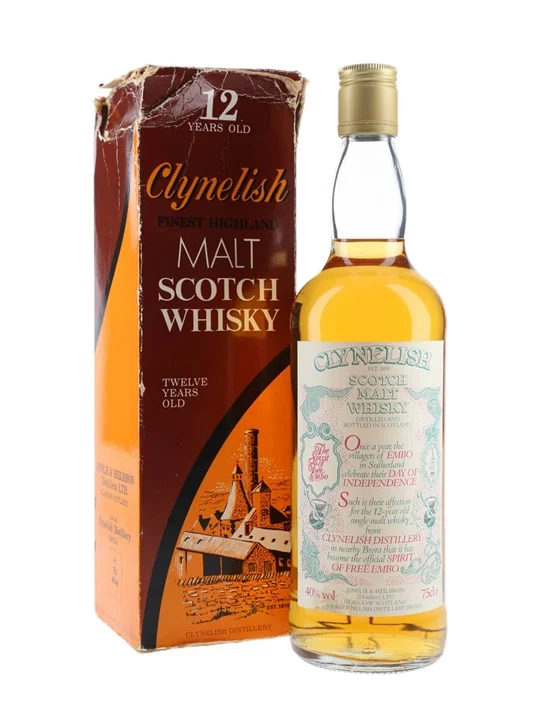

There are bottles you drink, and there are bottles that ask you to sit with them a while. The Clynelish 12 Year Old, released under the Spirit of Free Embo banner and bottled in 1988, belongs firmly in the latter category. This is a Highland whisky from another era — one that predates the premiumisation craze, the influencer-led hype cycles, and the speculative frenzy that now defines so much of the secondary market. It is, quite simply, a piece of whisky history in glass.
The Spirit of Free Embo bottling carries particular significance for those who know the Sutherland coastline. Embo, a small village just north of Dornoch, has deep roots in Highland community life, and charitable bottlings tied to its preservation efforts have become collectors' touchstones. Finding one from 1988 in any condition is notable. Finding one still sealed is increasingly rare.
What to Expect
Clynelish has long been regarded as one of the unsung workhorses of Highland whisky. Distillery character from this period tends toward a distinctive waxy, slightly honeyed profile — a signature that has earned Clynelish a quiet but devoted following among blenders and single malt enthusiasts alike. At 12 years old and bottled at a standard 40% ABV, this is not a cask-strength powerhouse. It was never intended to be. This is a whisky built for balance and approachability, the kind of dram that rewards patience rather than demanding attention.
A 1988 bottling means the spirit was likely distilled in the mid-1970s, a period when production methods and cask management across the Highlands differed meaningfully from today's norms. Expectations should be calibrated accordingly: think softer texture, gentler integration, and a style of whisky-making that prioritised harmony over headline ABV figures. The age and provenance are what justify the price tag here — you are paying for scarcity and a snapshot of a distillery's character nearly four decades ago.
The Verdict
At £2,500, this is unambiguously a collector's bottle, and I think it earns that positioning. The combination of a respected Highland distillery, a meaningful charitable bottling, and a 1988 date code places it in a narrow category of whiskies that function as both liquid and artefact. I have had the privilege of tasting old Clynelish from this general era, and the distillery's character holds up remarkably well with time — that waxy backbone gives the spirit a structural integrity that many lighter Highland malts simply cannot match over decades.
I would rate this 8.2 out of 10. It loses nothing for what it is; the slight reservation is simply that 40% ABV from this period can occasionally feel a touch restrained compared to what the spirit might have delivered at a higher strength. But that is a minor quibble against what is otherwise a compelling and historically significant bottle. For the serious collector or the Highland completist, this is one worth pursuing.
Best Served
If you do open it — and I would not blame you either way — serve it neat in a tulip glass at room temperature. Give it fifteen minutes to breathe after pouring. A whisky of this age and provenance deserves the time, and you may find it opens considerably once it has had a chance to settle. No water, no ice. Let the spirit speak for itself.