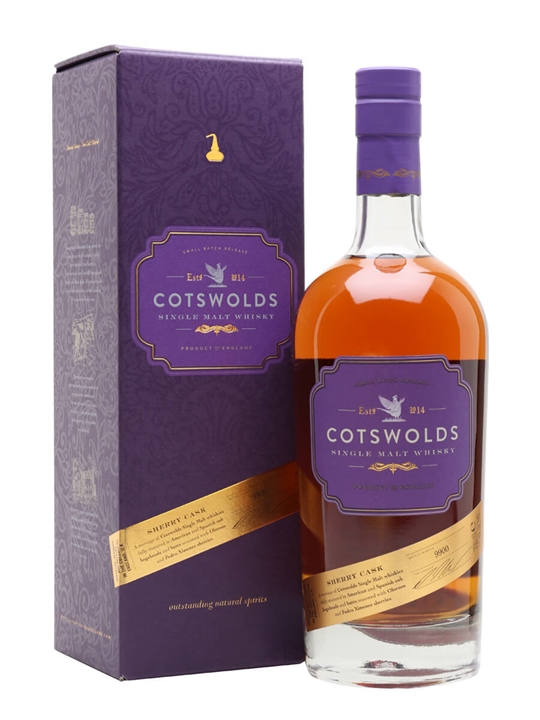

English whisky has, in a relatively short span, moved from curiosity to credible contender. The Cotswolds Sherry Cask Single Malt is one of the more convincing arguments for that shift — a cask-strength expression bottled at a punchy 57.4% ABV that signals serious intent from a distillery still finding its stride in a crowded single malt landscape.
Let me be plain: I approached this bottle with measured expectations. English single malt remains a young category, and sherry cask expressions live or die by the quality of the wood and the distiller's patience. At NAS, there is no age statement to lean on, which means the liquid has to do all the talking. And at cask strength, there is nowhere to hide. What I found in the glass was a whisky that understands what it is trying to be — rich, fruit-forward, unapologetically full-bodied — and largely succeeds.
The sherry influence here is the defining characteristic. This is not a whisky that whispers about its cask heritage; it announces it. Expect the kind of dense, dried-fruit sweetness that good Oloroso wood delivers, layered over a malt backbone that carries enough weight to stand up to the high ABV. At 57.4%, this is not a gentle sipper straight from the bottle — it demands a little water, and rewards you for the patience.
Tasting Notes
I have not published formal nose, palate, and finish notes for this expression yet. What I can say is that the sherry cask profile dominates the experience. If you enjoy the darker, richer end of the single malt spectrum — think Christmas cake, stewed orchard fruits, baking spice — this sits firmly in that territory. The cask strength bottling preserves a texture and intensity that would be diminished at 40 or 43 percent. Full tasting notes will follow once I have spent more time with this bottle, as a whisky at this strength deserves multiple sessions before committing anything to the record.
The Verdict
At £69.25, the Cotswolds Sherry Cask sits at a price point where it faces stiff competition from established Scottish and Irish distilleries with decades of sherry cask experience. That said, it holds its own. The cask-strength bottling adds genuine value — you are getting a more concentrated, uncompromised expression than many competitors offer at similar prices. A rating of 7.6 out of 10 reflects a whisky that is well-made, confident in its identity, and genuinely enjoyable, while acknowledging that English single malt as a category still has ground to cover before it commands the same authority as its Scottish counterparts. This is a bottle I would recommend to anyone curious about where English whisky is headed, and to sherry cask enthusiasts looking for something outside the usual rotation.
Best Served
Add a teaspoon of water — perhaps two. At 57.4%, this whisky needs it, and frankly improves with it. The water opens up the sherry character and softens the alcohol heat without flattening the texture. A Glencairn glass, a splash of still water, and fifteen minutes of patience after pouring. Do not rush cask-strength whisky. If you are feeling less formal, this would also work beautifully in a short, simple serve — a measure over a single large ice cube, allowed to open slowly as the ice melts. I would avoid mixing it into cocktails; the sherry profile and the price point both argue against it.