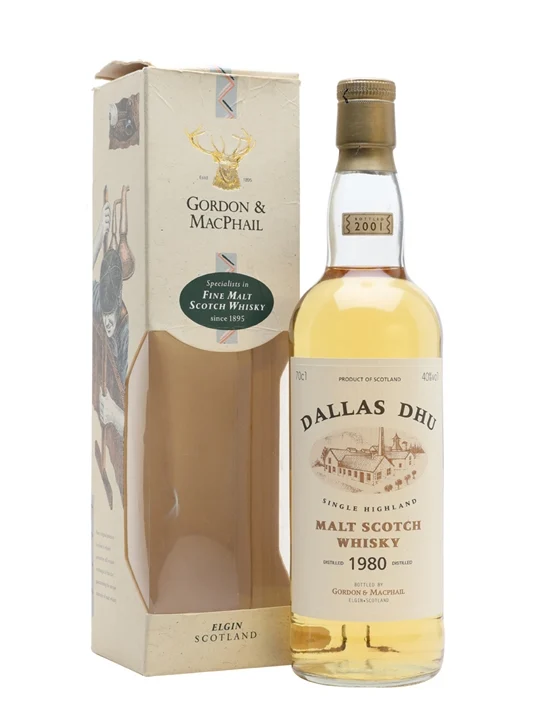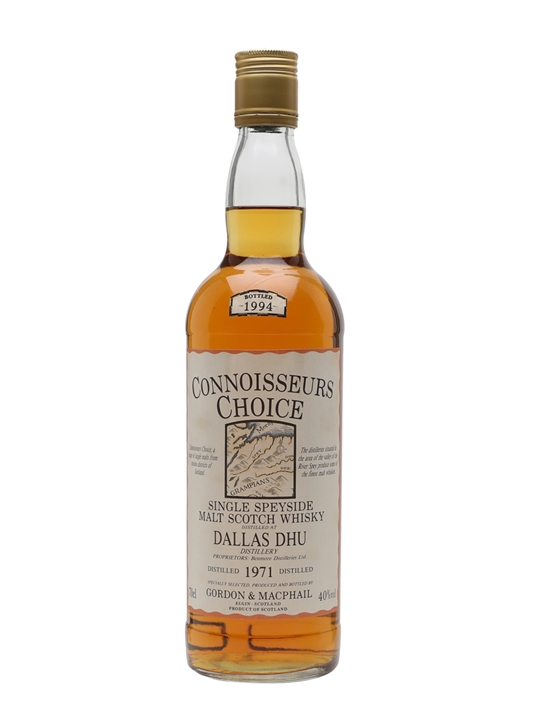

There are bottles that sit on the shelf and quietly remind you that whisky is, at its heart, a product of time and place. The Dallas Dhu 1971, bottled in 1994 under Gordon & MacPhail's Connoisseurs Choice label, is precisely that kind of bottle. Distilled in 1971 and given roughly twenty-three years in cask before release, this is a Speyside whisky from a distillery that no longer produces — Dallas Dhu fell silent in 1983 and today operates as a Historic Scotland museum. Every remaining bottle is, by definition, irreplaceable.
Gordon & MacPhail have long been the custodians of Scotland's rarest casks, and their Connoisseurs Choice range has introduced countless drinkers to distilleries they might never otherwise encounter. That this particular bottling was released at 40% ABV is typical of the era — cask strength releases were far less common in the early 1990s, and the standard practice was to bring everything down to a gentle, approachable proof. Some will argue that diminishes the experience. I'd counter that over two decades of maturation at this strength has allowed the wood and spirit to reach a settled equilibrium that higher-proof bottlings sometimes lack.
At £600, this is not an everyday purchase. But context matters. You are buying a piece of distilling history — spirit from a distillery that has been closed for over forty years, selected and matured by one of Scotland's most respected independent bottlers. The secondary market for Dallas Dhu of this vintage often commands considerably more. For the collector or the serious Speyside enthusiast, this represents genuine value relative to what comparable silent distillery bottlings now fetch at auction.
Speyside as a region is synonymous with elegance, fruit, and a certain honeyed refinement. A 1970s distillation from this part of the Highlands, given over two decades of cask maturation, sits firmly in the tradition of old-style Speyside whisky — the kind of dram that rewards patience and attention. This is not a whisky that shouts. It is one that speaks quietly and expects you to listen.
Tasting Notes
I have not provided formal nose, palate, and finish breakdowns for this bottling, as individual cask variation at this age means tasting notes can differ meaningfully between bottles. What I will say is this: expect the hallmarks of long-aged Speyside — mature oak influence, a gentle complexity, and the kind of depth that only genuine time in cask can deliver. At 40% ABV, it will be soft on the tongue and understated in its delivery.
The Verdict
This is a whisky I rate at 8 out of 10, and I do so with confidence. The score reflects not just what is in the glass but what the bottle represents: a vanished distillery, a respected bottler's judgement, and over two decades of unhurried maturation. It is a serious Speyside whisky for serious drinkers. The 40% ABV keeps it accessible, and the provenance gives it a weight that transcends the liquid alone. If you find one, and the price is right for your means, do not hesitate.
Best Served
Neat, at room temperature, in a tulip-shaped nosing glass. If you feel it needs it, add no more than a few drops of still water — but give it time in the glass first. A whisky of this age and rarity deserves your full attention. This is not a dram for mixing or for casual evenings. Set aside a quiet half hour, pour generously, and let it unfold at its own pace.