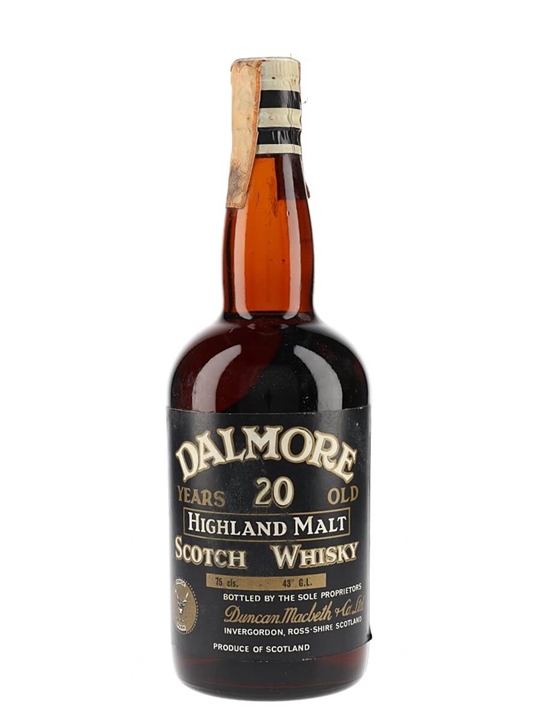

There are bottles you drink, and there are bottles that ask you to sit with them awhile. The Dalmore 20 Year Old, bottled sometime in the 1960s, belongs firmly in the latter category. This is a Highland single malt from a different era of Scotch whisky — two decades of maturation followed by more than half a century sealed in glass. At £3,750, it is not a casual purchase. But then, nothing about this whisky is casual.
What we have here is a snapshot. A liquid time capsule from a period when distilling in the Highlands operated under different economic pressures, different barley strains, different expectations of what a prestige single malt ought to be. The 1960s bottling places the distillation somewhere in the early-to-mid 1940s — wartime or immediate post-war Scotland. Production constraints during that period often meant smaller, more characterful runs. Malt distilled under those conditions tends to carry a weightiness, a density of flavour, that modern efficiency has largely streamlined away.
At 43% ABV, this sits at what was then a standard bottling strength for quality single malt — not cask strength, but robust enough to carry the full architecture of twenty years in oak. Highland malts of this vintage and age tend toward a particular richness: dried fruits, polished leather, beeswax, old mahogany furniture. The Dalmore house style has long favoured sherry cask influence, and at two decades of maturation, you would expect that to be deeply embedded rather than merely decorative.
Tasting Notes
I must be transparent here: detailed tasting notes for this specific bottling are not available to me at the time of writing. What I can say with confidence is that a 20-year-old Highland single malt from this era, bottled at 43%, will almost certainly deliver a profile of considerable depth and complexity. The age alone guarantees significant oak integration, while the period of production suggests a spirit with more robust cereal character than many contemporary releases. Collectors and experienced drinkers will know what territory we are in — this is old-school Scotch, before marketing departments discovered the word "luxury."
The Verdict
An 8.3 out of 10 reflects genuine quality tempered by practical reality. This is a serious collector's whisky — the kind of bottle that commands attention on any shelf and respect in any glass. The combination of a reputable Highland name, twenty years of maturation, and a bottling date more than sixty years ago creates something that simply cannot be replicated. You are not just buying whisky; you are buying provenance. The price is steep, but for what this represents — a piece of post-war Scottish distilling, preserved in glass — it is not unreasonable within the vintage market. I have given it a strong score because the fundamentals are right: the age, the strength, the pedigree. What holds it back from the very highest marks is the uncertainty that comes with any bottle of this age. Storage conditions over six decades matter enormously, and there is always an element of faith involved.
Best Served
Neat, and only neat. If you have gone to the trouble of acquiring a bottle from the 1960s, you owe it the respect of a proper tasting glass — a Glencairn or a tulip — at room temperature. Pour modestly. Let it sit for ten minutes before nosing. A few drops of soft water may open it further once you have taken the measure of it undiluted, but I would resist anything beyond that. This is not a whisky for mixing, for ice, or for haste. It is a whisky for a quiet room and an unhurried evening.