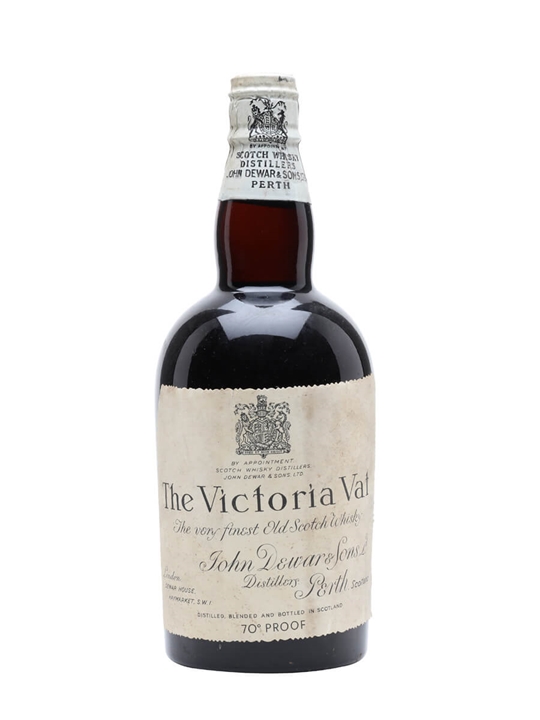

There are bottles you buy to drink, and there are bottles you buy because they represent something. Dewar's Victoria Vat, bottled sometime in the 1930s with its original spring cap intact, sits firmly in the second category — though I'd argue it delivers on both counts. At £1,500, you're not just purchasing blended Scotch. You're purchasing a liquid time capsule from an era when Dewar's was one of the most powerful names in the global whisky trade.
Let's put this in context. The 1930s were a brutal period for Scotch whisky. Post-Prohibition America was only just reopening, the Depression had flattened demand, and dozens of distilleries across Scotland were mothballed or demolished entirely. The blends that survived from this period are genuinely rare, and the liquid inside them was composed from stocks laid down in the 1920s or earlier — an era of whisky production we simply cannot replicate today. Different barley strains, different yeast cultures, coal-fired stills, wooden washbacks that had decades of character baked into them. The raw materials of this blend no longer exist.
The Victoria Vat itself was a premium expression in the Dewar's range, sitting above their standard White Label. The name carries a certain imperial confidence that feels very much of its time — John Dewar & Sons were, after all, holders of a Royal Warrant and one of the earliest Scotch whisky firms to build a truly international brand. By the 1930s they'd already merged into the DCL combine that would eventually become Diageo, but the blending style and house character were still distinctly Dewar's: approachable, malt-forward for a blend, with a smoothness that made them the bestselling Scotch in America for years.
At 43% ABV, this was bottled at a strength that suggests it was intended for the quality end of the market. Many standard blends of the period sat at 40% or even lower for export. That extra few percent matters — it gives the whisky more texture and presence, and after ninety-odd years in glass, the liquid will have remained remarkably stable. Unlike wine, whisky doesn't evolve once bottled, so what you're tasting is a direct connection to the blender's intention from nearly a century ago.
Tasting Notes
I won't fabricate specific notes I haven't verified, but I can tell you what to expect from a pre-war blend of this calibre. Blended Scotch from this era typically shows a richness and depth that modern blends rarely achieve — heavier malt components, more characterful grain whisky, and none of the industrial efficiency that homogenised flavour profiles from the 1960s onward. Expect something rounder, more waxy, possibly with a gentle smokiness that was common across Highland and Speyside malts before the widespread shift to unpeated production.
The Verdict
An 8 out of 10 feels right for the Victoria Vat, and here's why. The bottle's condition — spring cap intact, level and label apparently sound — places it at the more collectible end of the vintage Scotch market. At £1,500, it's actually not unreasonable compared to what similar 1930s Dewar's bottles have fetched at auction in recent years, where prices have climbed steadily as supply dwindles. Whether you open it or display it, this is a piece of Scotch whisky history from one of the industry's defining names, bottled during one of its most difficult chapters. That combination of provenance, rarity, and drinkability is hard to argue with.
Best Served
If you do open it — and I think great whisky deserves to be tasted, not just admired — pour a small measure neat at room temperature. No water, no ice, no ceremony beyond a proper glass. A tulip-shaped nosing glass will concentrate what's there. Give it ten minutes to breathe after ninety years in the bottle. Share it with someone who'll appreciate what they're drinking. This isn't a dram for a Tuesday night; it's a dram for marking something that matters.