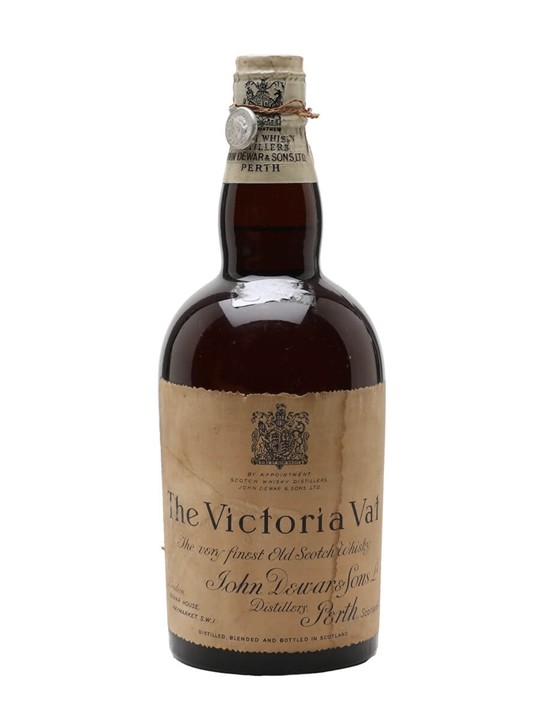

There are bottles you buy to drink, and there are bottles you buy because they represent something. Dewar's Victoria Vat, bottled sometime in the 1950s with its original spring cap intact, falls firmly into the second category — though I'd argue it still has plenty to say in the glass.
Let me be direct about what you're looking at here. This is a piece of blended Scotch history. The Victoria Vat was one of Dewar's premium expressions during the mid-twentieth century, a period when blended Scotch absolutely dominated world whisky. We're talking about an era when single malts were largely the preserve of locals and the odd eccentric collector. The blend was the thing, and houses like Dewar's were the architects of global whisky culture. A bottle like this is a window into that world.
At 43% ABV, this was bottled at a strength that suggests confidence in the liquid. Many blends of this era were brought down to 40% or even lower for export markets, so the extra few points suggest this was intended for drinkers who wanted substance. The spring cap closure is a useful dating marker — it places production squarely in the 1950s, before screw caps became the industry standard.
What to Expect
I won't pretend to give you precise tasting notes that would hold up to scrutiny — every bottle of this age will have evolved differently depending on storage conditions, fill level, and simple luck. What I can tell you is that well-stored blended Scotch from this period tends to carry a richness and complexity that surprises people raised on modern blends. The component malts and grains available to Dewar's blenders in the post-war years were drawn from distilleries running at different capacities, with different yeast strains and longer fermentation times than today's efficiency-driven operations. The resulting spirit had character that's genuinely difficult to replicate.
Expect a certain waxy, honeyed quality if the bottle has been well kept. Old blends often develop a roundness and integration that makes them feel seamless — the grain and malt components become almost indistinguishable from one another after decades in glass.
The Verdict
At £1,000, you're paying for rarity and provenance as much as liquid. That's the honest truth of the vintage whisky market. But here's the thing — compared to single malts of equivalent age and scarcity, this is actually reasonable. A 1950s bottling of almost any Highland single malt would command multiples of this price. The blended Scotch category remains undervalued in the collector market, which means bottles like the Victoria Vat represent genuine drinking history at prices that haven't yet gone completely mad.
Is it worth it? If you're a student of Scotch whisky history, absolutely. If you want to understand what blended Scotch was before the industry consolidated and cost-optimised everything, this is primary source material. I'm giving it a 7.7 — a strong score that reflects both the quality of the liquid in context and the sheer fascination of drinking something assembled by blenders working seventy-odd years ago. The only reason it doesn't score higher is the inherent uncertainty of any bottle this old.
Best Served
Neat, at room temperature, in a proper nosing glass. Give it twenty minutes to open up after pouring — old whisky needs time to wake up. If you're feeling brave, a few drops of water may coax out additional complexity, but go carefully. This isn't a bottle for cocktails or casual mixing. Treat it as an occasion, pour small measures, and pay attention. You're drinking a time capsule.