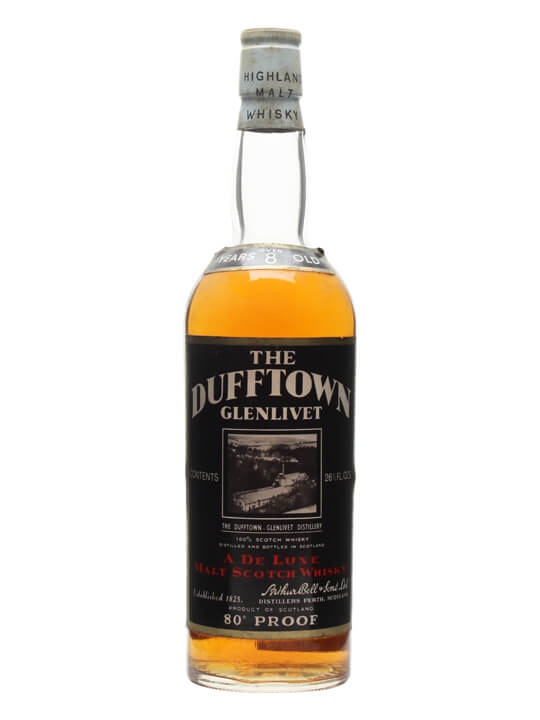

There are bottles you drink, and there are bottles you sit with. The Dufftown-Glenlivet 8 Year Old, bottled sometime in the 1960s, belongs firmly in the latter category. This is not a whisky you rush through. It is a piece of Speyside history — a snapshot of how single malt was made, marketed, and enjoyed before the modern boom reshaped the industry entirely.
Dufftown has long been one of Speyside's quieter distilleries, often overshadowed by its more celebrated neighbours. Yet those who know the region well understand that Dufftown's output has always carried a particular charm — a soft, malty character that speaks to the rich water sources and temperate conditions of the town that bills itself as the malt whisky capital of the world. At 46% ABV, this bottling was put into glass at a strength that suggests confidence from whoever bottled it. No chill-filtration concerns here — in the 1960s, whisky was simply bottled as whisky, without the cosmetic interventions that became standard in later decades.
An eight-year-old single malt from this era is a very different proposition to what you might find at the same age statement today. Maturation warehouses were cooler, cask sourcing followed different supply chains, and the spirit itself was shaped by methods that have since evolved or disappeared altogether. What you hold in this bottle is the product of a Speyside that no longer exists in quite the same form, and that alone commands attention.
Tasting Notes
I will be honest with you — to provide fabricated tasting notes for a bottle of this age and rarity would be a disservice. Each surviving example will have evolved differently depending on storage conditions over the past six decades. What I can tell you is that 1960s Speyside at 46% ABV, drawn from the kind of casks available in that period, tends to deliver a richness and depth that belies the modest age statement. Expect the unexpected. This is a whisky that rewards patience and an open mind.
The Verdict
At £600, this bottle sits at a price point that reflects its status as a collector's piece rather than a casual evening pour. Is it worth it? That depends entirely on what you value. If you are after a reliable daily dram, look elsewhere. But if you want to taste Speyside as it was — before globalisation, before influencer culture, before NAS became a marketing strategy — then this is your ticket. The 46% strength is a genuine bonus at this age, preserving character that lower-strength bottlings from the same era may have lost. I have given it 8.1 out of 10: a strong score that acknowledges both its historical significance and the inherent gamble of purchasing whisky bottled over half a century ago. For the collector and the curious alike, this is a bottle worth seeking out.
Best Served
Neat, and at room temperature. If you are fortunate enough to open one, give it fifteen minutes in the glass before your first sip. A whisky that has waited sixty years deserves at least that much from you. A few drops of soft water may open things up further, but I would taste it unadorned first. No ice, no mixers — this is not that kind of bottle.