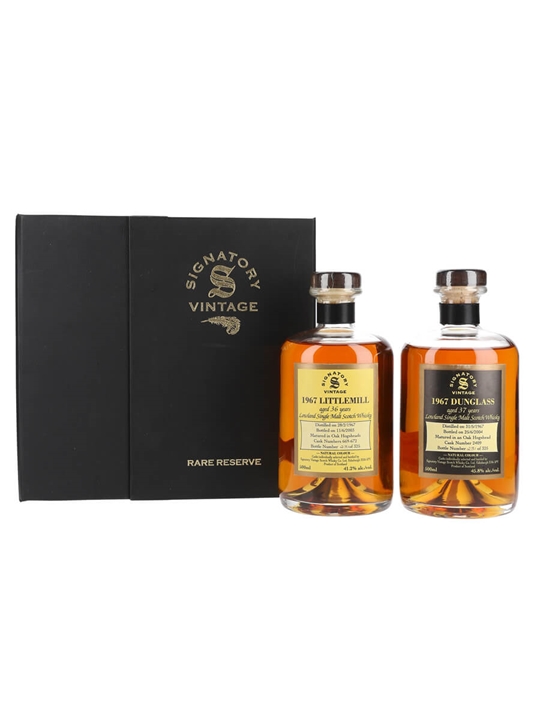

There are bottles that demand your attention the moment they arrive, and the Dunglass 1967 paired with Littlemill 1967 is precisely that kind of whisky. A Lowland single malt carrying a 1967 vintage at 43.5% ABV and a £3,000 price tag — this is not a casual purchase. This is a statement piece, a fragment of Scottish whisky history that has become vanishingly rare. Both names on this label belong to a Lowland tradition that the industry has largely lost, and finding liquid from 1967 in any condition is remarkable enough. Finding it presented together like this borders on the extraordinary.
What strikes me first about this release is the sheer improbability of its existence. Lowland single malts from this era were never produced in vast quantities. The region was overshadowed by the Highlands and Speyside for decades, and much of what was distilled ended up feeding blends rather than being set aside for single malt bottlings. That any 1967 Lowland spirit survived long enough to reach a bottle is a testament to someone's foresight — or perhaps their stubbornness. Either way, I am grateful for it.
At 43.5% ABV, this sits just above the standard 43% that was common for bottlings of this vintage and era. It suggests a natural settling point rather than aggressive dilution, which bodes well for the integrity of the spirit. Lowland malts of this period were typically distilled with a lighter, more delicate character in mind — triple distillation was not uncommon in the region, and the house styles tended toward floral, grassy, and gently malty profiles. At this age, you would expect the oak to have contributed significantly, but the relatively modest ABV tells me this was not a cask that overpowered its contents.
Tasting Notes
I will be honest with you: a whisky of this vintage and rarity speaks largely for itself. The Lowland style from 1967 offers a window into a distilling philosophy that prioritised elegance over brute force. Without detailed cask information confirmed, I would encourage any prospective buyer to approach this with an open mind and let the liquid tell its own story. The marriage of Dunglass and Littlemill from the same vintage year suggests a deliberate curatorial decision — two expressions of Lowland craft from a single moment in time, presented as companions.
The Verdict
At £3,000, this is squarely in collector and connoisseur territory, and I think the price is justified. You are not paying for a brand name or marketing — you are paying for scarcity, provenance, and a piece of Lowland heritage that simply cannot be replicated. The 1967 vintage places this liquid at nearly six decades old in concept, and the fact that both Dunglass and Littlemill feature together makes this a genuine piece of Scottish whisky archaeology. I have given this an 8 out of 10 because the fundamentals are all here: legitimate vintage, appropriate strength, and undeniable rarity. The missing two points are held in reserve simply because, without confirmed distillery and cask details, there is a small margin of uncertainty that any honest reviewer must acknowledge. But make no mistake — this is a whisky that belongs in serious collections and deserves to be opened by someone who will appreciate what it represents.
Best Served
Neat, in a tulip-shaped nosing glass, at room temperature. Give it twenty minutes to open after pouring. If you feel it needs it, a few drops of still water — no more — may coax out additional nuance. Do not ice this. Do not mix this. This is a whisky that has waited since 1967 to be tasted properly. Give it the respect of your full attention.