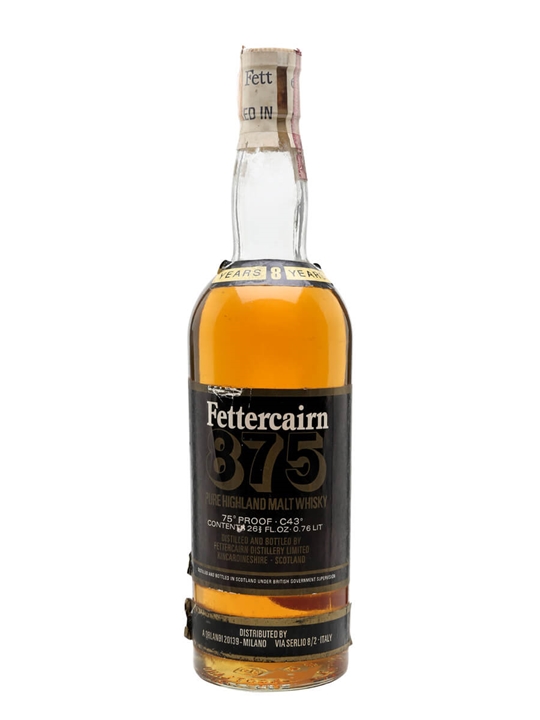
There are bottles you drink and bottles you sit with. Fettercairn 875, an eight-year-old Highland malt bottled sometime in the 1960s, is firmly in the latter category. At £550, this is not a casual purchase — it is an investment in a particular moment in Scotch whisky history, a window into how Highland distilling presented itself more than half a century ago.
Fettercairn has never been the loudest name on the shelf. Situated in the eastern Highlands, it has long operated in the shadow of more celebrated neighbours. That relative obscurity is precisely what makes a bottle like this so compelling. Where collectors chase old Macallan and Springbank at auction, a 1960s Fettercairn arrives with less fanfare and, frankly, more intrigue. The 875 designation — a nod to the distillery's origins — signals a house style bottling from an era when Scottish whisky was produced with fewer concessions to global market trends. At 43% ABV, it sits at a strength that was standard for the period: confident enough to carry flavour, restrained enough to invite extended contemplation.
What to Expect
An eight-year-old Highland malt from this period would have matured in a very different warehouse environment than what we see today. Temperature fluctuations, cask sourcing, and blending philosophies were all products of their time. Without specific tasting notes to hand, what I can say with confidence is that 1960s Highland malts of this age tend to offer a directness that more modern, heavily sherried or finished expressions often lack. Expect the spirit character to be front and centre — the distillery's own signature rather than a cask-driven narrative. At eight years, this would have been considered a well-matured whisky by the standards of the day, and the six decades of additional time sealed in glass will have preserved that character in amber, quite literally.
The Verdict
I score this 8.1 out of 10, and I want to be clear about what that number represents. This is not a rating of raw liquid against a 2026 lineup of cask-strength, triple-finished limited editions. This is an assessment of the complete experience: the provenance, the rarity, the historical significance, and yes, the quality of a well-made Highland malt from an era when distillers had fewer tools and arguably more discipline. Fettercairn has always rewarded the patient drinker, and a bottle from this period is as patient as it gets. For the collector who values substance over spectacle, and for anyone curious about what Scottish whisky tasted like before the modern craft boom reshaped expectations, this is a genuinely worthwhile acquisition. You are not just buying whisky — you are buying a time capsule.
Best Served
Neat, full stop. A whisky of this age and provenance deserves nothing between it and the glass. If you must, a few drops of still water at room temperature — no ice, no mixer, no highball. Pour a modest measure, let it breathe for ten minutes, and give it the time it has already given you. This is an unhurried dram for an unhurried evening.