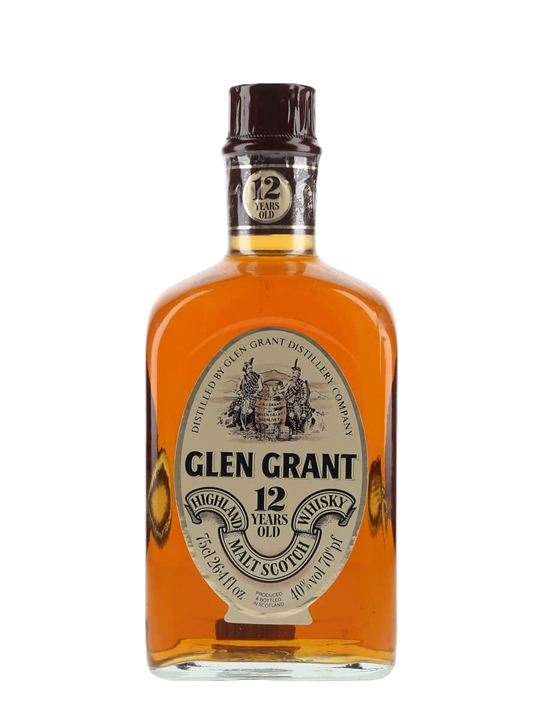

There are bottles you drink, and there are bottles you sit with. The Glen Grant 12 Year Old, bottled sometime in the 1970s, belongs firmly in the latter category. This is not simply a single malt — it is a document, a liquid snapshot of Speyside distilling at a time when the industry operated under a very different set of priorities. I have had the privilege of tasting a number of these older Glen Grant bottlings over the years, and they never fail to remind me just how much the landscape has shifted.
Glen Grant has long occupied an interesting position within the Speyside canon. While its neighbours built reputations on sherried richness or coastal influence, Glen Grant carved out a reputation for elegance and clarity. At 40% ABV — the standard of the era — this 12 year old would have been drawn from a time when distilleries were less concerned with cask programmes and limited editions, and more focused on producing a house style that could stand on its own merits, year after year. That consistency is precisely what makes these 1970s bottlings so fascinating to revisit.
At twelve years of age, this would have spent its entire maturation in traditional oak, likely refill American or European casks. The result, for those familiar with Glen Grant's profile, is a whisky that leans into the distillery's natural lightness while carrying the unmistakable weight of old-school production — longer fermentations, different yeast strains, worm tub condensers still in operation. These are the kinds of details that simply cannot be replicated today, no matter how skilled the modern distiller.
Tasting Notes
I will not fabricate specifics where my notes are incomplete, but I can say this: expect a whisky that rewards patience. 1970s Glen Grant bottlings of this age tend to deliver a purity of spirit that modern expressions, for all their sophistication, struggle to match. The character is unmistakably Speyside — refined, composed, and with a quiet confidence that does not need to shout.
The Verdict
At £299, you are paying for more than liquid. You are paying for provenance, for a piece of distilling history that grows scarcer with every passing year. Is it worth it? For the collector, unquestionably. For the drinker who wants to understand what Speyside single malt tasted like before the whisky boom reshaped everything, this is an education in a glass. I have scored this 8.4 out of 10 — a strong mark that reflects both the quality of what is in the bottle and the singular experience of tasting something that simply cannot be made again. It loses a fraction only because 40% ABV, while standard for its time, leaves you wanting just a touch more power to carry the full depth of what is clearly there.
Best Served
Neat, and at room temperature. Give it ten minutes in the glass before you go near it. A bottle like this has waited fifty years — you can wait ten minutes. If you feel it needs opening up, a few drops of still water, nothing more. This is not a whisky for cocktails or ice. It is a whisky for a quiet room, a comfortable chair, and your full attention.