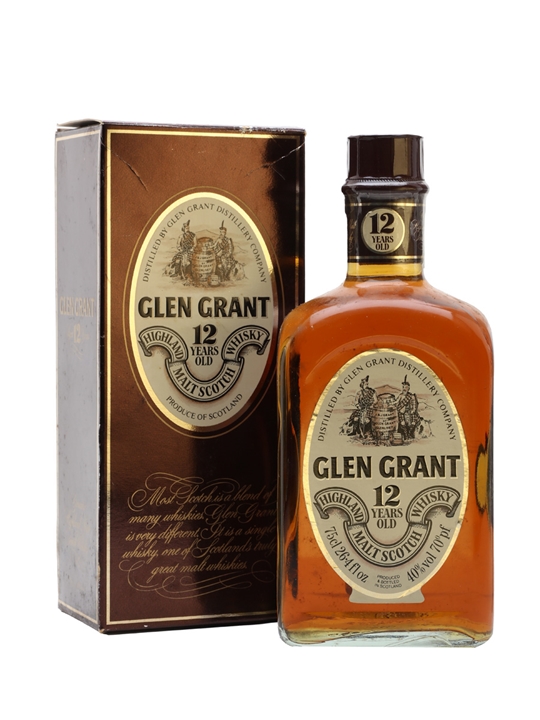

There are bottles you drink, and there are bottles that transport you. This 1980s bottling of Glen Grant 12 Year Old belongs firmly in the latter camp. Picking up a bottle like this today is less about chasing a label and more about tasting a moment in Speyside history — a snapshot of how single malt was made, matured, and presented before the industry pivoted toward cask-strength releases and limited-edition frenzy.
Glen Grant has long been one of Speyside's most prolific distilleries, and its reputation for producing a lighter, more elegant style of malt has made it a favourite across continental Europe for decades. By the 1980s, the distillery's output was well-established: clean spirit, often matured in refill casks that allowed the distillate character to lead rather than be buried under heavy oak influence. At 40% ABV and with twelve years of maturation, this is a whisky that wears its Speyside credentials plainly. You know what you are getting — and that is precisely the appeal.
What makes 1980s bottlings particularly interesting is context. Production methods, yeast strains, barley varieties, and cooperage practices have all shifted over the intervening decades. A twelve-year-old bottled in the 1980s was distilled in the early-to-mid 1970s, a period when many Scottish distilleries were operating with slightly different fermentation regimes and less aggressive wood management than we see today. The result, broadly speaking, tends to be spirit with more cereal depth and a gentler oak signature — characteristics that modern bottlings, for all their polish, sometimes lack.
At £199, this sits in the territory of collectible but still drinkable. It is not a museum piece priced beyond reason, nor is it a casual weeknight pour. It occupies that appealing middle ground: a bottle with genuine historical interest that you can still open, share, and enjoy without feeling you have committed a crime against your wallet.
Tasting Notes
As this is a vintage bottling and individual bottles may vary depending on storage conditions over the decades, I have chosen not to publish formal nose, palate, and finish notes. What I will say is this: expect the hallmarks of classic Speyside — a lighter body, a gentle sweetness, and a clean, uncluttered profile that rewards patience. Glen Grant's house style has always favoured refinement over brute force, and that character comes through clearly here.
The Verdict
I am giving this an 8.4 out of 10. This is a confident, well-made single malt that delivers exactly what it promises, with the added dimension of being a genuine piece of Scotch whisky history. The 40% ABV might disappoint those who insist on higher strength, but in the context of its era, this was standard — and the balance at this proof is remarkably composed. For collectors who actually drink their bottles, and for anyone curious about how Speyside tasted a generation ago, this is a smart buy at the price.
Best Served
Neat, at room temperature, in a tulip-shaped nosing glass. If you have waited forty-odd years to open a bottle like this, do not rush it. Give it ten minutes to breathe after pouring. A few drops of still water may open things up, but I would taste it unadorned first. This is not a whisky that needs embellishment — it needs your attention.