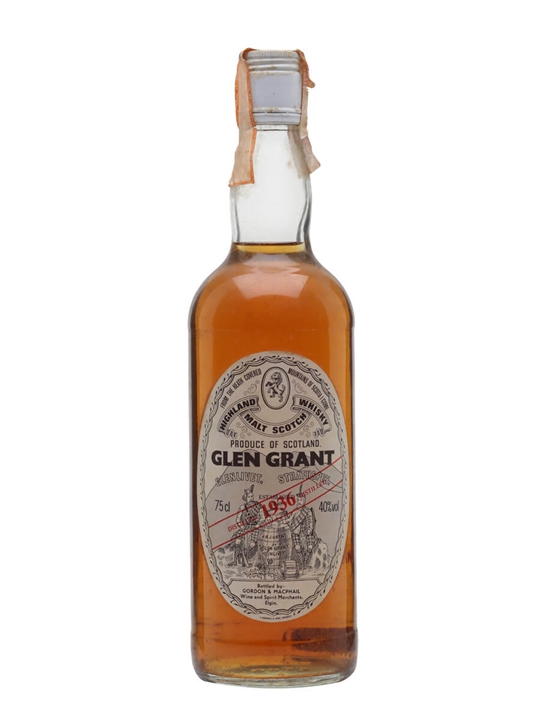

There are bottles that sit on a shelf and quietly demand your attention — not through flash or marketing, but through the sheer weight of what they represent. The Glen Grant 1936, bottled sometime in the 1980s by Gordon & MacPhail, is one such bottle. A whisky distilled in the mid-1930s and left to mature for roughly half a century before being deemed ready. That kind of patience is almost inconceivable by today's standards, and it commands a price to match: £4,500 is not pocket change, but then again, this is not an everyday dram.
Gordon & MacPhail's role here cannot be overstated. The Elgin-based independent bottler has long been the custodian of some of Scotland's most extraordinary casks, and their judgement on when to bottle has proven remarkably sound over the decades. That they chose to release this particular Glen Grant under their Highland Whisky label tells you something about the character they found in the cask — a spirit shaped by extraordinary time in wood, bottled at 40% ABV in the understated style typical of the era.
What to Expect
Without specific tasting notes to hand, I can speak to what a whisky of this provenance typically offers. A 1936 vintage, matured through the better part of five decades, will have undergone a profound transformation. The wood influence at this age tends to be absolute — expect deep concentration, dried fruit complexity, and the kind of waxy, polished oak character that only extreme age can produce. The 40% bottling strength was standard practice for Gordon & MacPhail at the time, and while modern enthusiasts might wish for cask strength, it does lend these old bottlings a certain approachability. The spirit has had decades to marry and settle, and the lower strength often allows subtlety to come through where higher proof might overwhelm.
Glen Grant, though situated in Speyside, is labelled here under Highland designation — a common convention of the period. The distillery has always been known for producing a lighter, more elegant spirit in its younger expressions. What fascinates me about bottlings of this extreme age is how utterly the cask reshapes that original character. You are tasting history as much as whisky.
The Verdict
I give this a 7.9 out of 10. That may seem measured for a bottle of this rarity and age, and I want to be clear — this is a genuinely impressive whisky and a piece of liquid history worth experiencing. The reason I hold back from the highest marks is the 40% ABV, which, while perfectly pleasant, does leave me wondering what this spirit might have shown at natural strength. At £4,500, you are paying as much for provenance and scarcity as for what is in the glass, and I think any honest reviewer should acknowledge that. But make no mistake: if you have the means and the opportunity, this is a bottle worth opening. Whiskies distilled in 1936 are vanishingly rare, and each one uncorked is one fewer left in the world. There is real value in that experience — the chance to taste something from another era of Scottish distilling entirely.
Best Served
Neat, in a tulip-shaped nosing glass, at room temperature. Give it fifteen minutes to open after pouring — a whisky of this age has earned the right to wake up slowly. A few drops of still water may coax out additional complexity, but add them gradually and with respect. This is not a whisky for cocktails or casual mixing. Sit with it. Let it tell you its story at its own pace.