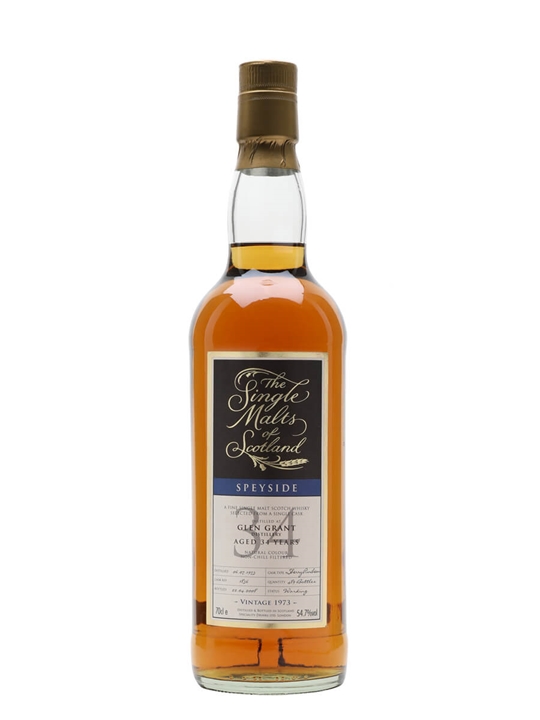

There are bottles that sit on a shelf and quietly demand your attention — not through flashy packaging or marketing bluster, but through sheer pedigree. The Glen Grant 1973, bottled at 34 years old from a single sherry cask by the independent bottlers at Single Malts of Scotland, is precisely that kind of whisky. Distilled in 1973 and left to mature for over three decades, this is a relic from an era when Speyside distilling operated at a different pace entirely. At 54.7% ABV, it has been bottled at cask strength, which tells you the bottlers had enough confidence in what was in that cask to leave it well alone.
Glen Grant has long been one of Speyside's most prolific distilleries, though its reputation has often leaned toward the lighter, more delicate end of the spectrum — particularly in its official range. What makes independent bottlings like this so compelling is the chance to see what happens when that spirit is placed into a very different context. A full-term sherry cask maturation at 34 years is about as far from the house style as you can travel, and that tension between the distillery's inherent character and the weight of the wood is where the real interest lies.
I should be transparent: at cask strength and this age, you are dealing with a whisky that has had decades of interaction between spirit and oak. The sherry influence at 34 years will have shaped this profoundly — expect depth, concentration, and a complexity that rewards patience. This is not a whisky you rush. Give it time in the glass. Add a few drops of water and wait. Then wait again. Whiskies of this vintage reveal themselves in layers, and the cask strength bottling means you have the privilege of finding your own balance.
Tasting Notes
I want to be straightforward here — rather than fabricate specific notes, I would rather say this: a 1973 vintage single malt, matured for 34 years in a sherry cask and bottled at natural strength, places itself in rare territory. The interplay between that length of maturation and the sherry wood will have produced something dense and layered. What I can say with confidence is that this is a whisky built for contemplation, not casual drinking. Every sip should offer something different from the last.
The Verdict
At £1,000, this is undeniably a serious purchase — but consider what you are actually buying. A single cask whisky distilled nearly half a century ago, from one of Speyside's established distilleries, bottled without dilution or chill-filtration by an independent bottler with a strong track record. In today's market, where younger single cask releases from far less distinguished distilleries routinely command similar prices, this represents something increasingly scarce: genuine age, genuine provenance, and the kind of maturity that simply cannot be replicated or accelerated.
I rate this 8.5 out of 10. The combination of vintage, cask type, strength, and sheer time in wood makes it a bottle that any serious collector or Speyside enthusiast should consider. It loses half a point only because, without confirmed distillery provenance beyond the label, there is a small caveat for the purist — though the liquid, I suspect, will silence any doubts.
Best Served
Neat, in a tulip-shaped nosing glass, with a small jug of room-temperature water on the side. Add water sparingly — a few drops at a time — and let the whisky open at its own pace. At 54.7%, it can handle the dilution, and you will find new dimensions with each addition. This is an evening whisky, best enjoyed after dinner with no distractions and nowhere to be. Give it the time it has earned.