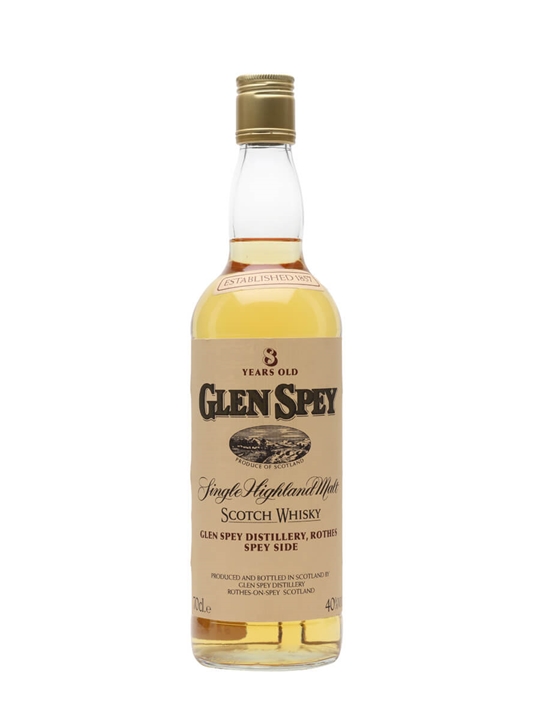

There is something quietly thrilling about uncorking a bottle that has sat undisturbed since the 1990s. This Glen Spey 8 Year Old, bottled sometime during that decade, represents a category of whisky that collectors and drinkers alike are increasingly drawn to — not for flash or fanfare, but for what it tells us about how Speyside single malts were presented a generation ago. Glen Spey has never been a household name, and that is precisely part of its appeal. At 40% ABV and carrying just eight years of maturation, this is a whisky that was bottled to be drunk, not displayed. That it now commands £350 says more about the market than the original intent.
A Speyside of Its Era
Glen Spey sits in the heart of Speyside, a region I have returned to dozens of times over the past fifteen years. The distillery has long operated in relative obscurity, with the vast majority of its output destined for blending — most notably for the J&B blend. Official single malt releases have always been scarce, which makes any bottling worth paying attention to. An 8-year-old expression from the 1990s would have been distilled in the mid-to-late 1980s, a period when many Speyside distilleries were still working with traditional worm tub condensers and less aggressive cask management. You would expect a lighter, more delicate spirit from that combination — grassy, gently sweet, with that classic Speyside approachability that made the region famous in the first place.
At 40% ABV, this was bottled at the legal minimum, which was standard practice for many official releases of the era. It is worth noting that this would have been a conscious choice — a whisky meant to be easy drinking, accessible, and representative of the house style rather than a cask-strength showpiece. There is no shame in that. Some of the most memorable drams I have had over the years were bottled at precisely this strength, where subtlety and balance matter more than raw intensity.
The Verdict
I score this Glen Spey 8 Year Old a 7.7 out of 10. That is a score I do not give lightly, and it reflects both what this whisky is and what it represents. As a drinking experience, an eight-year-old Speyside at 40% is never going to compete with older, higher-strength expressions for sheer complexity. But that is not the point. This bottle offers a genuine window into 1990s Scotch whisky — a time before the premiumisation wave reshaped how distilleries presented their single malts. It is honest, it is well-made, and it carries the quiet confidence of a distillery that has never needed to shout.
The £350 price tag is, of course, a collector's premium. You are paying for rarity, age of the bottle itself, and the increasingly scarce opportunity to taste old-style Speyside character. For the whisky curious, this is a worthwhile investment. For those who simply want a good dram, there are better value propositions on the shelf. But if you appreciate the history in your glass — and I firmly believe that context makes whisky taste better — this Glen Spey delivers something you cannot easily replicate with modern bottlings.
Best Served
Neat, at room temperature, in a tulip-shaped nosing glass. If you have spent £350 on a bottle from the 1990s, you owe it to yourself to experience it without interference. A few drops of still water after the first sip may open things up, but let the whisky speak first. This is not a cocktail ingredient — it is a conversation piece, and it deserves your full attention.