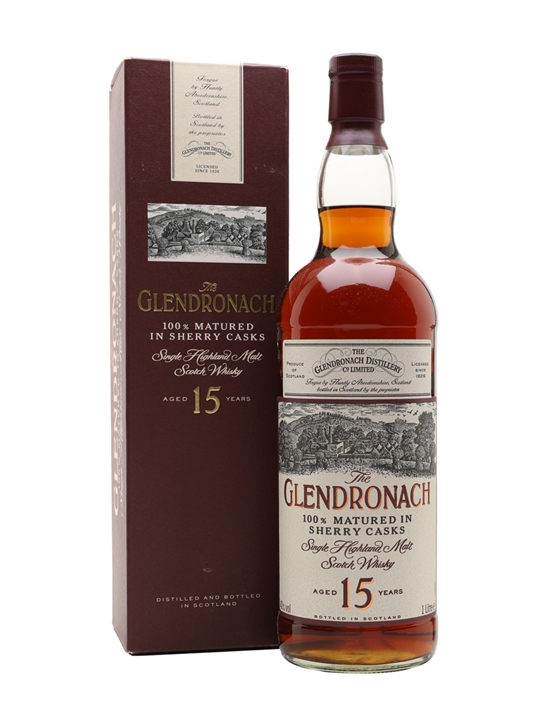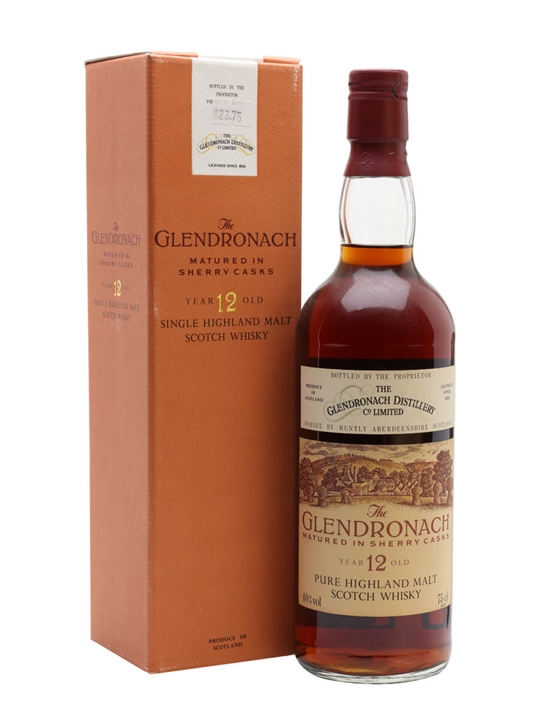

There are bottles you drink, and there are bottles that carry a story. The Glendronach 12 Year Old Sherry Cask, bottled sometime in the 1980s, falls squarely into the latter category. At £750, this is not a whisky you pick up on a whim — it is a piece of Highland history in glass, a snapshot of how sherry-matured Scotch was made before the industry shifted toward efficiency and global scale.
Glendronach has long been regarded as one of the Highlands' most committed sherry cask producers. A 1980s bottling of their 12 Year Old represents a period when the distillery was working with sherry casks that had genuinely held sherry — proper transport casks, not the seasoned wood we see commissioned today. That distinction matters enormously. The oak character from that era tends to carry a depth and authenticity that modern equivalents struggle to replicate, no matter how carefully the cooperages work.
At 40% ABV, this sits at the standard strength of its time. There was no cask-strength bottling culture in the 1980s for most distilleries — this was simply the way whisky was presented. What you lose in intensity you often gain in integration. A well-stored bottle from this period should deliver a spirit where the wood influence and the distillate have had decades of further marriage in the glass, evolving beyond what was intended at the point of bottling.
The Highland classification tells you to expect a whisky of substance. Glendronach's house style has always leaned towards the rich and full-bodied end of the spectrum, and the sherry cask maturation reinforces that. For a 12-year-old expression, you would expect the sherry influence to be prominent but not overwhelming — a whisky that wears its cask well without losing its identity beneath the wood.
Tasting Notes
As this is a vintage bottle with significant variation depending on storage conditions over the past four decades, I have chosen not to publish specific tasting notes. Each surviving bottle will have its own character, shaped by temperature fluctuations, fill level, and cork integrity. What I will say is this: if you acquire a well-stored example with a healthy fill level, you are likely to encounter a richness and coherence that modern bottlings at this age statement rarely achieve.
The Verdict
I am giving this an 8.3 out of 10. The score reflects both the quality of what Glendronach was producing in this era and the reality that a 1980s bottling carries inherent risk — you are buying provenance as much as liquid. A well-kept example is a genuine window into a different age of Scotch whisky production, when sherry casks meant something different and Highland distilleries operated at a pace that allowed character to develop naturally. The price is steep, but for collectors and serious enthusiasts who understand what they are buying, it represents a legitimate piece of whisky heritage. This is not an everyday dram — it is an occasion, a conversation, a reminder of where this industry came from.
Best Served
Neat, at room temperature, in a tulip-shaped nosing glass. If you are fortunate enough to open one, give it fifteen minutes to breathe after pouring. A whisky of this age and provenance deserves patience. No water, no ice — let it speak for itself. And for goodness' sake, share it with someone who will appreciate what they are drinking.