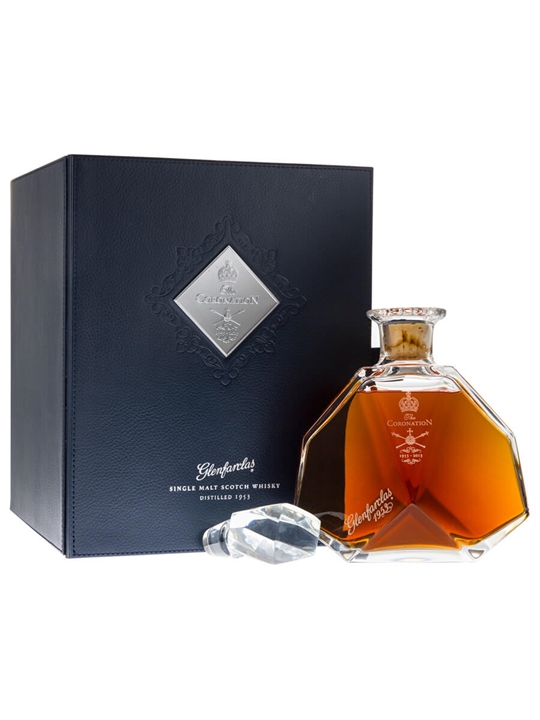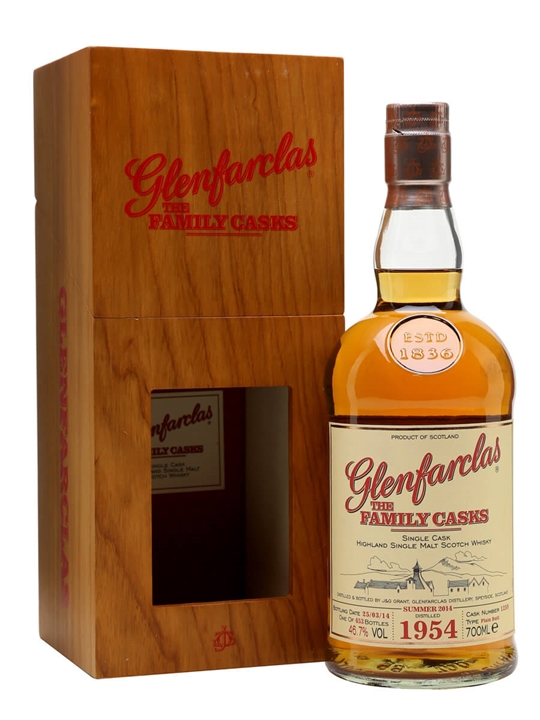

There are bottles you review, and there are bottles that stop you mid-pour. The Glenfarclas 1954, released as part of the Family Casks series under Cask 1260 in Summer 2014, belongs firmly in the latter category. A whisky distilled in 1954 and bottled sixty years later at a natural 47.2% ABV — that alone demands a moment of silence before you even think about nosing the glass.
The Family Casks series has earned its reputation as one of the most remarkable single cask programmes in Scotch whisky. Each release is drawn from an individual cask selected by the Grant family, and the 1954 vintage sits among the oldest expressions ever offered. At £8,500, this is not a casual purchase. It is a commitment — one that asks whether you believe a liquid six decades in oak can justify its extraordinary price. Having spent time with this bottle, I believe it comes remarkably close.
What to Expect
This is a Speyside whisky of extreme age, bottled at 47.2% without chill filtration. That strength, after sixty years in cask, tells you the wood has been generous but not greedy — enough spirit has survived to retain character rather than becoming an oak extract. Speyside malts of this vintage tend toward deep dried fruit, polished leather, and old library complexity, though every cask is its own story. Cask 1260 carries the weight of its years with what I found to be genuine composure. There is nothing hollow here, nothing that tastes like it is coasting on age alone.
At this ABV, the whisky has enough presence to fill the mouth without heat. You are not fighting through alcohol to find flavour — it arrives willingly, layered and unhurried. The texture has that almost oily viscosity that only comes from decades of slow maturation. This is a whisky that rewards patience in every sense of the word.
The Verdict
I am giving the Glenfarclas 1954 Family Casks Cask 1260 an 8.3 out of 10. That is a strong score, and I want to be clear about why. This whisky earns its marks through sheer depth of character and the remarkable fact that it has held together after six decades in wood. Too many ultra-aged whiskies become timber juice — all tannin and vanillin with the malt long since buried. This one has not. It remains recognisably a spirit with something to say, not merely a relic.
Where it loses marks, for me, is value. At £8,500, you are paying a significant premium for rarity and provenance. The liquid is excellent — genuinely excellent — but I have tasted younger Speyside casks at a fraction of the cost that deliver comparable pleasure, if not comparable history. If you are buying this bottle, you are buying a piece of distilling heritage as much as a dram, and you should make peace with that before reaching for your wallet.
For collectors and serious Speyside devotees, this is a landmark bottling. For drinkers who simply want something extraordinary in the glass, it delivers. Just know what you are paying for.
Best Served
Neat, in a tulip glass, at room temperature. Give it twenty minutes to open after pouring — a whisky this old has earned the right to wake up slowly. A few drops of soft water may coax out additional nuance, but I would taste it unadorned first. This is not a whisky for cocktails, ice, or haste. Sit with it. Let it unfold on its own terms.