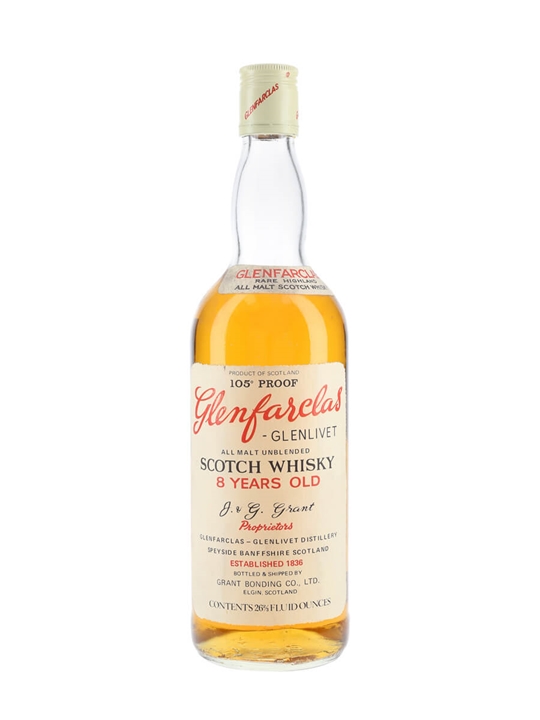

There are bottles you buy to drink, and there are bottles you buy because they represent a moment in time. The Glenfarclas 8 Year Old '105', bottled in the 1970s, falls squarely into the latter category — though I'd argue it still has plenty to say in the glass. At 60% ABV, this is cask strength Speyside from an era when the category operated under a different set of assumptions about what whisky should be, and who it was for.
For context, the '105' designation refers to the old British proof system — 105 degrees proof translating to 60% ABV. Glenfarclas has long been one of the few family-owned distilleries in Scotland, and their commitment to cask strength bottlings predates the current fashion for them by decades. To hold a 1970s example is to hold something from the period when cask strength was less a marketing proposition and more a straightforward statement of intent: this is the whisky as it was, uncut.
At eight years old, this is young by today's standards, but age statements carried different weight fifty years ago. The prevailing cask stock, warehousing conditions, and distillation character of that period produced spirits that matured on a different curve. An eight-year-old Speyside from the 1970s is not directly comparable to its modern equivalent. The wood policies, the barley varieties, the pace of production — all of it contributes to a spirit that belongs to its own time.
What to Expect
At 60% ABV, this demands patience. A whisky bottled at this strength over half a century ago will have continued to evolve under glass, and opening it is an event rather than a casual pour. Expect the robust, full-bodied character that the '105' range has always been known for — muscular Speyside with none of the lightweight fruitiness that the region is sometimes unfairly reduced to. This is the other side of Speyside: rich, assertive, built to fill a room.
The 1970s bottling era adds a collector's dimension. Presentation, label design, and closure style all speak to a different chapter in Scotch whisky's commercial history, and bottles from this period are increasingly scarce at auction and in specialist retail.
The Verdict
At £850, this is not a casual purchase — but it is, I believe, a fair one. Vintage cask strength Speyside from a respected family-owned distillery, bottled over fifty years ago, with provenance and character intact. I give it an 8 out of 10: a strong score that reflects both the quality of what Glenfarclas was producing in this era and the remarkable fact that bottles like this still surface at all. It loses the final marks only because, without opening it, any assessment must remain partly speculative — and at this price point, many buyers will keep the seal intact.
For the collector, it is a genuine piece of Scotch whisky history. For the drinker brave enough to open it, it promises an encounter with Speyside as it once was.
Best Served
If you do open this bottle, serve it neat in a tulip-shaped nosing glass and give it a full ten minutes to breathe before approaching. A few drops of still water at room temperature will be essential to unlock what sits beneath that 60% ABV — add them gradually, a drop at a time. Do not rush this. Do not add ice. This is a whisky that has waited over fifty years; you can wait ten minutes.