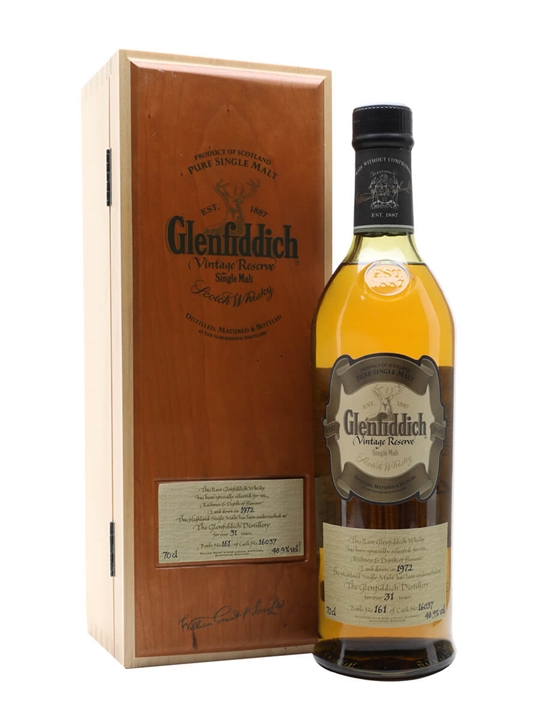

There are bottles that sit behind glass in auction houses and private collections, admired but never opened. The Glenfiddich 1972 Vintage Reserve, a 31-year-old Speyside single malt bottled at 48.9% ABV, is the kind of whisky that tempts you to break that rule. I did, and I'm glad of it.
A 1972 vintage carrying over three decades of maturation is a statement of intent. Glenfiddich is, of course, one of the most recognised names in Scotch whisky — the distillery that arguably did more than any other to popularise single malt worldwide. But recognition and quality are not always the same thing, and it's worth setting aside whatever assumptions the name carries. What matters here is what's in the glass, and what's in the glass is genuinely impressive.
At 48.9%, this sits just below cask strength, which tells you the distillery chose to present it with minimal intervention. That's a confident decision for a whisky of this age. Thirty-one years in oak will do extraordinary things to spirit, and the higher bottling strength preserves texture and complexity that would be flattened at 40% or 43%. You can feel that confidence the moment you pour it — there's a weight and presence here that cheaper bottlings simply cannot replicate.
What to Expect
Speyside as a region is known for a certain elegance — orchard fruits, honey, a gentle malt sweetness — and a whisky from 1972 with this kind of age will have had decades to develop depth well beyond those baseline characteristics. At 31 years old, you should expect the oak influence to be significant but, given Glenfiddich's reputation for careful cask management, controlled rather than dominant. The 48.9% ABV ensures there is enough spirit character to stand up to all that wood. This is not a whisky that will taste tired or over-oaked — it has backbone.
The Vintage Reserve designation signals that this was drawn from a specific year's production, which gives it a snapshot quality. You are tasting a particular moment in a distillery's history, shaped by the barley, the water, and the decisions made in that specific year. That matters. No two vintages are identical, and part of the pleasure of a bottle like this is knowing it cannot be repeated.
The Verdict
At £2,750, this is not an everyday purchase — nor should it be. This is a whisky for marking something, for sharing with someone who will appreciate what thirty-one years of patience produces. I give it an 8.5 out of 10. It earns that score through sheer presence and the unmistakable quality that comes from genuine age at a thoughtful bottling strength. There are older whiskies, and there are more expensive ones, but few deliver this particular combination of accessibility and gravitas. Glenfiddich has not relied on its name here; the liquid justifies the price.
Is it worth the investment? If you are a collector who never opens bottles, that's your business. But if you are someone who believes whisky is made to be drunk — and I firmly am — then yes. This is a bottle that rewards the act of opening it.
Best Served
Neat, in a tulip-shaped nosing glass, at room temperature. If you wish, add three or four drops of still water after your first pour — at 48.9%, a small addition can open things up without diminishing the structure. Do not rush this one. Give it twenty minutes in the glass before you form any opinions. A whisky that waited thirty-one years in the cask deserves at least that much of your time.