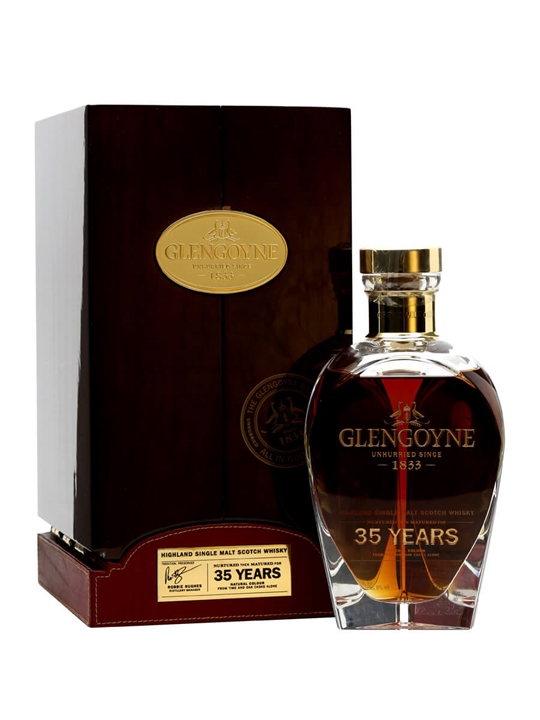

There are moments in this line of work when a bottle arrives and the weight of it — not just physical, but temporal — commands a certain pause. Glengoyne 35 Year Old is one of those bottles. Three and a half decades in oak is no small commitment from any distillery, and at 46.8% ABV, this has been bottled at a strength that suggests real confidence in the liquid. No hiding behind cask strength theatrics, no diluting down to an anonymous 40%. This is a considered bottling, and I respect that.
What to Expect
At 35 years of age, a Highland single malt of this calibre will have had ample time to develop extraordinary depth and complexity. The interaction between spirit and wood over that span tends to produce something layered and contemplative — the kind of whisky that changes in the glass over the course of an evening. With the ABV sitting at 46.8%, you can expect a whisky that still carries genuine presence on the palate without being overpowering. That's a sweet spot for aged expressions: enough strength to deliver the full spectrum of flavour, but sufficiently approachable that you needn't add water unless you choose to.
Highland single malts of this maturity typically lean into rich dried fruit, old oak, and a polished sweetness that only decades of slow extraction can produce. This is not a whisky that shouts. It whispers with authority.
The Verdict
Let me be direct about the price. At £4,500, this is a serious investment, and it should be judged as one. What you're paying for is time — 35 years of patience, evaporation, and careful cask management. Every year in the warehouse is a year of the angel's share quietly diminishing what remains, which makes what survives all the more precious. The economics of ultra-aged whisky are unforgiving, and pricing reflects that reality rather than mere aspiration.
I score the Glengoyne 35 Year Old an 8.6 out of 10. This is a Highland single malt that earns its place among the upper tier of aged Scotch. The 46.8% ABV is a mark of integrity — it tells me the distillery trusted the spirit to speak for itself at natural drinking strength rather than padding margins with water. For collectors and serious enthusiasts who appreciate what three decades of maturation actually means, this bottle delivers on its promise. It is not the most expensive 35-year-old on the market, nor the cheapest, but it occupies its price point with genuine conviction.
Best Served
A whisky of this age and complexity deserves the simplest possible treatment. Pour it neat into a tulip-shaped glass — a Glencairn will do nicely — and let it sit for ten minutes before nosing. If you feel the ABV needs softening, add no more than a few drops of room-temperature water. Anything more would be an act of vandalism. This is an after-dinner whisky, best enjoyed in a quiet room with no distractions, when you have the time and the inclination to pay attention to what 35 years of ageing has to say.