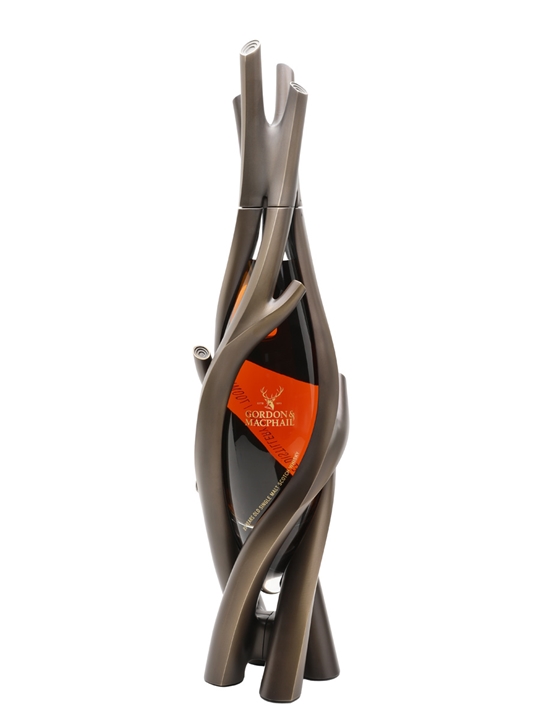

There are whiskies you review, and there are whiskies that stop you in your tracks. The Glenlivet 1940, released under Gordon & MacPhail's Generations series as 'Artistry in Oak,' belongs firmly in the latter category. Distilled in 1940 and matured for an extraordinary 85 years, this Speyside single malt is, quite simply, one of the oldest whiskies ever bottled. At £125,000, it asks a question few bottles dare to pose — and the answer, I believe, is more nuanced than the price tag alone suggests.
Gordon & MacPhail have long been the custodians of Scotland's most remarkable casks. Their Generations series exists specifically for releases of this magnitude — whiskies that have outlived their distillers, their coopers, and in many cases the world that created them. That this expression carries the Glenlivet name only deepens its significance. Speyside has always been the heartland of elegant, fruit-forward single malt, and to encounter a spirit that has spent the better part of a century drawing character from oak is to witness that regional identity stretched to its absolute limit.
At 43.7% ABV, this has been bottled at a strength that suggests the cask retained remarkable integrity over those 85 years. That alone tells you something important about the quality of the wood and the conditions under which it was stored. Many whiskies of extreme age fall below 40% and lose their structure entirely. The fact that this Glenlivet held above natural drinking strength after eight and a half decades is, in my experience, genuinely uncommon and speaks to careful, attentive warehousing across generations of staff.
What to Expect
With no confirmed tasting notes to report at the time of writing, I will say this: an 85-year-old Speyside single malt at this strength will almost certainly be defined by its oak influence — deep, resinous, and layered — balanced against whatever fruit character has survived the decades. Whiskies of this age tend toward dried tropical fruits, ancient polished wood, and a waxy, almost candle-like texture. The ABV suggests there is still life and presence on the palate, not merely a ghost of what once was. I would expect concentration rather than power, and a finish that lingers not because of heat but because of sheer density of flavour.
The Verdict
I have given this whisky an 8.6 out of 10. Some will argue that a score below 9 is harsh for an 85-year-old single malt at this price point. I would counter that no whisky earns its score from age or rarity alone — it earns it from what is in the glass. An 8.6 reflects my confidence that this is an exceptional, historically significant spirit that represents the absolute pinnacle of what long-term maturation can achieve. It is a whisky that matters. Whether it is worth £125,000 depends entirely on what you are buying: a drink, or a piece of Scottish distilling history. For those who understand the difference, the Artistry in Oak justifies itself.
Best Served
Neat, at room temperature, in a tulip-shaped nosing glass. Nothing else. No water, no ice, no distractions. A whisky that has waited 85 years deserves your full, undivided attention. Pour a small measure, let it breathe for ten minutes, and approach it slowly. This is not a dram you rush. It is one you sit with.