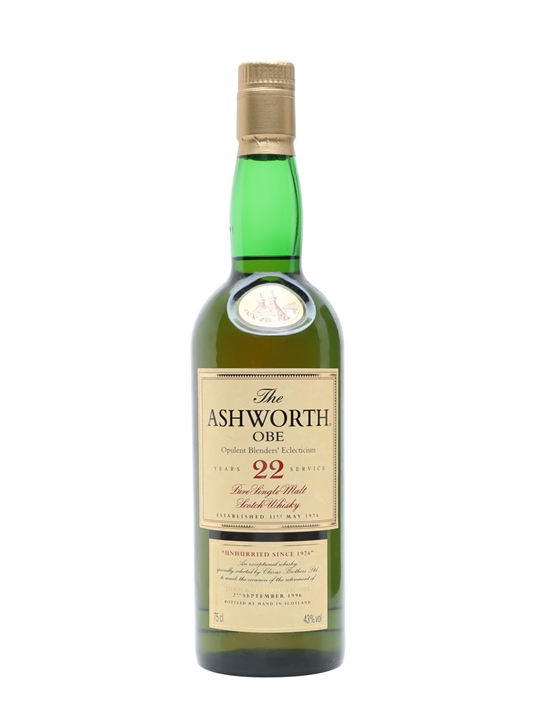

There are bottles that sit on the shelf and quietly demand your attention — not through flash or fanfare, but through sheer provenance. The Glenlivet 22 Year Old, distilled in 1974 and released under The Ashworth label, is precisely that kind of whisky. A Speyside single malt from the mid-seventies, bottled at a composed 43% ABV, this is a dram that speaks to a particular era of Scottish whisky-making, and it does so with considerable authority.
Let me be direct: a 1974 distillation from Speyside carries weight. The seventies were a period of transition across the Highlands and Speyside alike — production methods were shifting, worm tubs were still commonplace, and the character of spirit coming off the stills had a density and richness that modern efficiency has, in many cases, smoothed away. Twenty-two years in cask would have given this whisky ample time to develop the kind of layered complexity that shorter-aged expressions simply cannot replicate. At 43%, it sits just above the legal minimum for single malt, which suggests a bottling philosophy geared toward accessibility rather than cask-strength intensity. That is not a criticism. Sometimes restraint is the point.
The Ashworth name may not be instantly familiar to every collector, but independent bottlings of this vintage and age from Speyside distilleries have earned a loyal following among those who know what they are looking for. This is a whisky that rewards patience — both the patience it took to mature and the patience you should bring to the glass.
Tasting Notes
I have not published detailed tasting notes for this particular bottling at the time of writing. What I can say is that a 22-year-old Speyside from this era will almost certainly deliver on the hallmarks of the region: expect a whisky that leans toward orchard fruit, aged oak, and a gentle sweetness underpinned by that characteristic Speyside elegance. The 43% bottling strength suggests a whisky designed for balance rather than brute force — a composed, dignified pour.
The Verdict
At £2,000, this is unambiguously a collector's whisky. You are paying for vintage, for age, and for the increasingly rare opportunity to taste Speyside spirit from over five decades ago. Is it worth it? That depends entirely on what you value. If you are chasing intensity and modern cask experimentation, look elsewhere. If you want to understand what Speyside tasted like in the mid-seventies after two decades of quiet maturation, this bottle offers something that no amount of money can recreate — time captured in glass. I rate this 8.6 out of 10. It earns that score not through spectacle but through the quiet confidence of a whisky that has nothing left to prove. The vintage provenance and extended maturation speak for themselves, and for the serious collector or the whisky historian, this is a genuinely compelling bottle.
Best Served
Neat, at room temperature, in a tulip-shaped nosing glass. Give it ten minutes to open after pouring. If you feel inclined, a few drops of still water at room temperature will coax out additional nuance, but I would suggest tasting it unadorned first. This is not a whisky for cocktails or highballs. It has earned the right to stand alone.