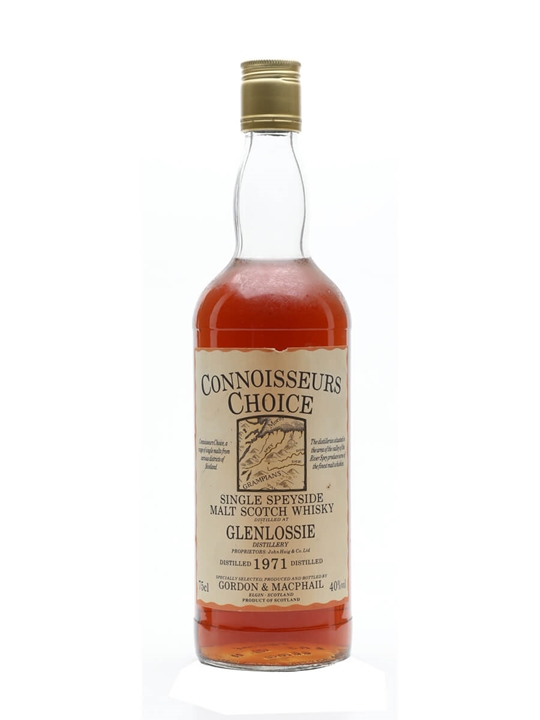

There are bottles that sit on a shelf and quietly remind you that whisky, at its best, is a record of time. The Glenlossie 1971, bottled sometime in the 1980s under Gordon & MacPhail's Connoisseurs Choice label, is precisely that kind of bottle. It represents a period of Scotch production that we simply cannot replicate today — distilled in an era when Speyside's character was shaped as much by the pace of life as by the copper and the barley.
Glenlossie has never been a household name. It sits in that fascinating category of Speyside distilleries whose output has historically fed the blending vats rather than commanding single malt attention. That relative obscurity is, frankly, part of the appeal. When an independent bottler like Gordon & MacPhail selected casks from Glenlossie in this era, they were choosing on pure quality rather than brand recognition. The Connoisseurs Choice range has always operated on that principle — find something worth drinking and let it speak.
Bottled at 40%, this is a whisky of its time. The standard strength tells you something about the conventions of the period, when cask strength bottlings were rare outside of specialist circles. What you lose in intensity you often gain in approachability, and a 1970s Speyside malt at this strength tends to carry a particular kind of grace — lighter in body, perhaps, but with a complexity that comes from genuine age and the oak profiles typical of that decade's cask stock.
What to Expect
Without documenting specific tasting notes on this occasion, I can speak to the style with some confidence. A 1971 Speyside malt bottled roughly a decade later would have spent its formative years in casks that were, by today's standards, remarkably traditional. You should expect the hallmarks of old-style Speyside — a certain waxy, honeyed quality, orchard fruit that leans towards stewed rather than fresh, and that telltale nuttiness that marks well-kept spirit from this region and era. The 40% ABV will present this gently, without heat, letting subtlety do the heavy lifting.
The Verdict
At £550, this is not an everyday purchase, and I would not pretend otherwise. But context matters enormously. You are buying a whisky distilled over fifty years ago, from a distillery that rarely appears as a single malt, selected by arguably the most experienced independent bottler in Scotland. For collectors and serious enthusiasts, that combination carries real weight. The price reflects scarcity and provenance rather than marketing, which is something I can respect.
I give this an 8.2 out of 10. It earns that score not through spectacle but through authenticity. This is a genuine artefact of 1970s Speyside whisky-making, bottled by people who understood what they had in the cask. It loses a fraction for the 40% bottling strength — I cannot help but wonder what this spirit might have offered at 43% or above — but that is a criticism of the era's conventions, not of the whisky itself. If you find one in good condition, it is a piece of Scotch history worth having.
Best Served
Neat, at room temperature, in a tulip-shaped nosing glass. Give it ten minutes to open after pouring. A whisky of this age and delicacy does not need water, ice, or company — just your full attention and perhaps a quiet evening. If the nose seems closed after resting, a single drop of water may coax out further detail, but proceed carefully. You will not get a second bottle easily.