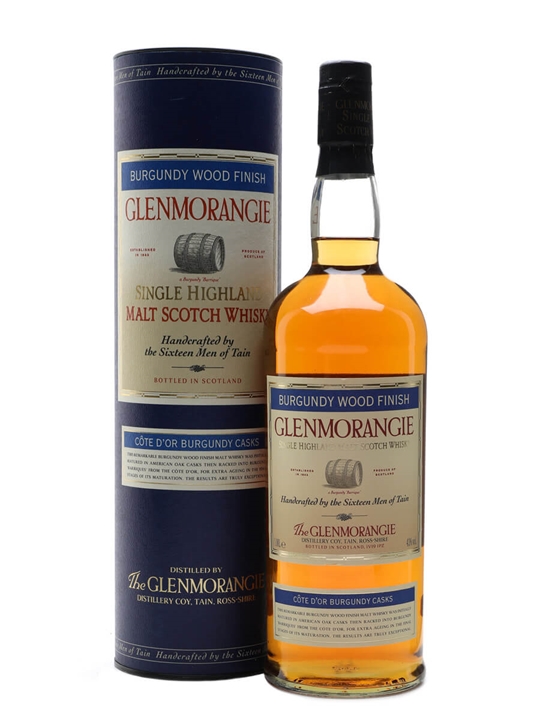

There are bottles that sit on the secondary market like quiet monuments to an era of experimentation, and the Glenmorangie Burgundy Finish — bottled sometime in the 2000s — is precisely that. This is a whisky from a period when Glenmorangie's wood management programme was producing some genuinely remarkable cask-finished expressions, long before wine-finish bottlings became the default play for every distillery with a marketing department.
Glenmorangie has always been a Highland distillery that punches with finesse rather than brute force. The famously tall copper pot stills — the tallest in Scotland — produce a spirit that is light, fruity, and almost delicate in its new-make character. That kind of spirit is a natural canvas for cask finishing, and when you introduce Burgundy wine casks into the equation, you are layering red fruit depth and tannic structure onto something already poised and elegant. At 43% ABV, this sits at the standard strength Glenmorangie favoured for its finished range during that period — enough to carry flavour without heat.
Tasting Notes
I will not fabricate specific notes where my records are incomplete. What I can tell you is what to expect from the style. A Burgundy finish on Highland malt of this character typically introduces dried red berries, a gentle spice from the oak, and a vinous quality that sits somewhere between plummy sweetness and dry, almost savoury tannin. The base spirit from Glenmorangie — with its characteristic orchard fruit and vanilla backbone — should provide a clean, approachable foundation. This is not a whisky that will assault the senses. It is one that rewards patience and attention.
The Verdict
At £250, you are paying for provenance and scarcity rather than age statement credentials. This is a discontinued expression from a distillery whose early wood-finish experiments are now regarded as benchmarks. The Burgundy Finish was never as celebrated as the Madeira or Port Wood releases, which in my view makes it one of the more interesting bottles to seek out — it flew under the radar, and bottles from this era are becoming increasingly difficult to find in good condition.
I am giving this an 8.1 out of 10. That reflects a whisky that represents genuine quality and historical interest within Glenmorangie's range, balanced against the reality that NAS Highland malt — however well finished — is competing at a price point where age-stated single cask bottlings also live. For the collector or the Glenmorangie enthusiast, the value proposition is clear. For the casual drinker, this is a treat bottle, not an everyday pour.
Best Served
Neat, in a Glencairn, with ten minutes of rest in the glass. If you find the wine influence initially dominant, a few drops of still water will open up the base spirit and bring the Highland character forward. This is not a cocktail whisky — at this price and with this heritage, give it the respect of drinking it on its own terms.