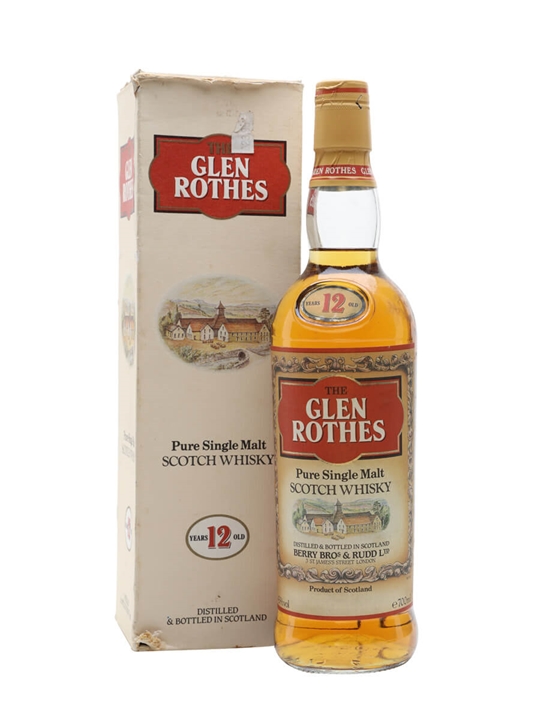

There are bottles you drink, and there are bottles that carry a timestamp. The Glenrothes 12 Year Old, bottled sometime in the 1980s, is firmly in the latter camp. At £225, you are not simply buying a Speyside single malt — you are buying a window into how Scotch whisky tasted before the category was reshaped by global demand, chill-filtration debates, and the cult of limited editions. This is a bottle from an era when Glenrothes was still relatively quiet, still a blender's secret, and still bottling at a respectable 43% ABV.
What makes 1980s-era Glenrothes fascinating is context. A 12-year-old bottled in that decade was likely distilled in the early-to-mid 1970s — a period when Speyside distilleries were running with a confidence born of steady demand and well-established production routines. Glenrothes has always sat in the softer, fruit-forward corner of the Speyside map, closer to Macallan's neighbourhood in Rothes than to the grassy lightness you might find further north. The distillery's long fermentation times and relatively slow distillation have historically produced a spirit with weight and sweetness, and I would expect this vintage bottling to carry those hallmarks faithfully.
Tasting Notes
I will be honest with you: rather than fabricate specific notes, I would rather tell you what to expect from the style. A 1980s Glenrothes at 12 years and 43% should deliver the kind of rounded, sherried Speyside character that defined the region before the industry pivoted toward bourbon-cask-heavy profiles. Think orchard fruit, a touch of spice, and that unmistakable old-bottling softness that collectors talk about — a texture that seems to have quietly disappeared from many modern releases. At 43%, it has just enough strength to hold its own without the burn that higher-proof bottlings demand.
The Verdict
I have tasted enough vintage Speyside to know that not every old bottle lives up to nostalgia, but the Glenrothes name at this age and from this period carries genuine credibility. The £225 price point is fair for what is essentially a piece of Scotch history — you would pay considerably more for equivalent-era Macallan, and I would argue Glenrothes from this period is every bit as interesting, if less fashionable. This is not a bottle for showing off. It is a bottle for a quiet evening when you want to taste what Speyside meant before the marketing departments got involved. At 8.4 out of 10, it earns its score through provenance, integrity, and the simple fact that well-made whisky from a good distillery, given proper time and kept in good condition, rarely disappoints.
Best Served
Neat, in a Glencairn, at room temperature. If you must, a few drops of still water to open things up — but this is a 43% malt from a gentler era, and it does not need much coaxing. Pour slowly. Pay attention. Bottles like this do not come around often, and they certainly are not being made anymore.