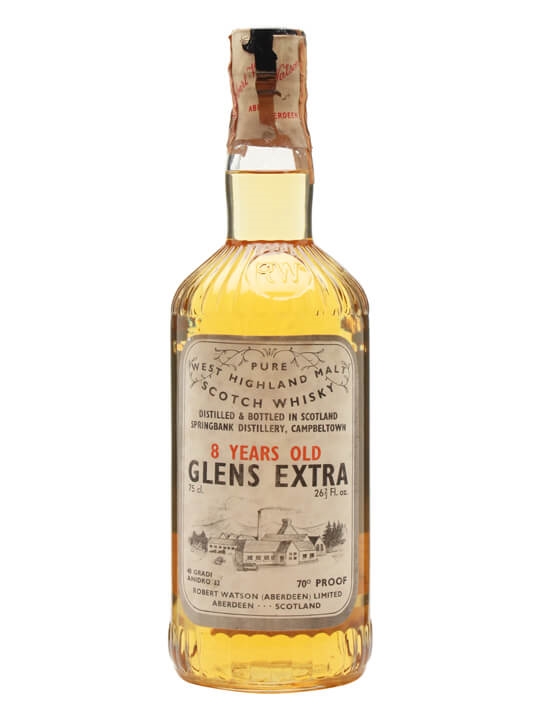

There are bottles that sit on a shelf and quietly demand your attention — not through flash or marketing, but through sheer provenance. The Glens Extra 8 Year Old, bottled sometime in the 1960s and bearing the Springbank name on its label, is precisely that sort of whisky. At £1,500, it asks a serious question of any collector or drinker, and I think it earns the right to ask it.
Let me be clear about what we know and what we don't. The label references Springbank, and the bottle itself is described as a Campbeltown whisky — yet the distillery attribution remains unconfirmed. That ambiguity is not unusual for bottles of this era. Labelling conventions in the 1960s were, to put it diplomatically, less rigorous than what we expect today. What we can say with confidence is that this is a piece of Scotch whisky history, bottled at 40% ABV with eight years of maturation behind it, from a period when Campbeltown's remaining distilleries were producing spirit under very different conditions to the modern day.
What to Expect
An eight-year-old whisky bottled over half a century ago will have continued to evolve in the glass, and the experience of opening something from this period is always singular. Whisky of this vintage, particularly from the Campbeltown tradition, tends to carry a character shaped by the production methods of the time — smaller stills, less temperature control, and a hands-on approach to every stage of the process. At 40% ABV, this was bottled at the standard strength of the era, which typically yields a softer, more approachable delivery than the cask-strength bottlings we've grown accustomed to chasing.
The Campbeltown style, broadly speaking, has always occupied its own corner of the Scotch map — neither as briny as Islay nor as polished as Speyside. If this bottle does indeed trace its origins to that peninsula, you should expect something with real substance and individuality, even at a modest age statement.
The Verdict
I'm giving this an 8 out of 10, and I want to explain why. This is not a bottle you buy purely for what's inside — though I have every reason to believe the liquid is excellent. You buy it because it represents a vanishing chapter of Scotch whisky. Bottles from 1960s Campbeltown are genuinely scarce. The town's distilling heritage was in decline during that decade, and anything that survived from that period carries real historical weight. The price reflects that scarcity honestly. I've seen comparable bottles from confirmed Springbank stock of this era fetch similar figures at auction, and the market is not wrong to value them. For the collector, this is a sound acquisition. For the drinker brave enough to open it, it promises an encounter with a style of Scotch that simply no longer exists in this form.
Best Served
If you do choose to open this bottle — and I would respect either decision — serve it neat in a tulip glass at room temperature. Give it ten minutes to breathe before your first sip. A whisky of this age and vintage deserves patience. A few drops of still water may open it further, but start without. This is not a cocktail whisky, nor a casual dram. It is a conversation with the past, and it deserves your full attention.