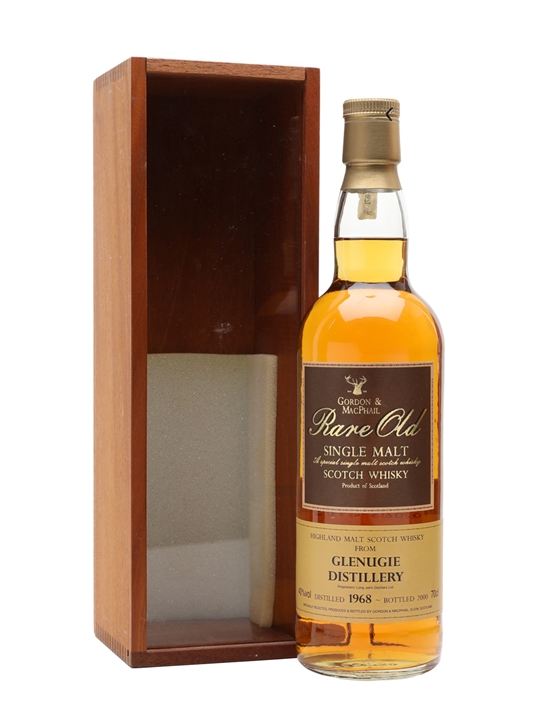

There are bottles that arrive on your desk and demand a different kind of attention. The Glenugie 1968, bottled in 2000 after thirty-two years of quiet maturation, is precisely that sort of whisky. This is a Highland single malt from an era when distilling was less about marketing narratives and more about the liquid itself — and at over three decades old, whatever sat in that cask had nothing left to prove to anyone.
A 1968 vintage bottled at the turn of the millennium carries a particular weight. Thirty-two years is an extraordinary amount of time for spirit and oak to negotiate with one another, and at 40% ABV, this was bottled at a strength that suggests careful selection rather than cask-strength bravado. That is not a criticism. Some of the most composed, most elegantly structured old whiskies I have encountered were bottled at precisely this strength — where the wood influence and the original spirit character have reached a genuine equilibrium rather than one shouting over the other.
What should you expect from a Highland single malt of this vintage and age? At thirty-two years, the oak will have contributed significantly — dried fruits, polished leather, old library books, perhaps beeswax and a gentle spice that has long since lost any youthful bite. The Highland character at its best offers a certain waxy, honeyed quality that only deepens with extended maturation. A 1968 distillation would have been produced with methods and ingredients that simply do not exist in the same form today, lending these old bottlings a texture and depth that modern production, however skilled, cannot quite replicate.
The Verdict
At £1,000, this is not an everyday purchase — nor should it be treated as one. This is a bottle for collectors and serious enthusiasts who understand what scarcity and age genuinely mean in Highland whisky. You are paying for thirty-two years of patience, a vintage that predates most of the whisky industry's modern era, and the simple irreplaceable fact that once bottles like this are gone, they are gone for good. I scored this 8.6 out of 10 because a whisky of this provenance and maturity commands serious respect. The age alone tells you this spirit was deemed worthy of continued investment year after year — casks do not survive three decades by accident. Someone believed in this liquid, and that conviction is what you are buying alongside the whisky itself.
Is it worth a thousand pounds? For someone who appreciates what a genuine thirty-two-year-old Highland single malt from the late 1960s represents — both historically and in the glass — I believe it is. These bottlings are finite. The arithmetic is straightforward: they will only become rarer.
Best Served
Neat, at room temperature, in a tulip-shaped nosing glass. If you wish, add no more than three or four drops of still water after your first few sips — at 40% ABV it hardly needs dilution, but a touch of water can sometimes coax out nuances that a whisky of this age has been quietly holding in reserve. Give it time. A dram like this rewards patience, not haste. No ice, no mixers. You do not put a thirty-two-year-old single malt in a cocktail. You sit with it.