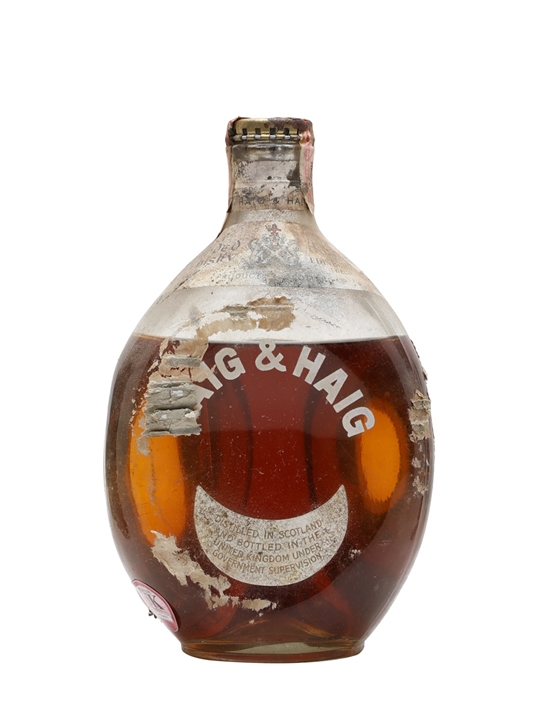

There are bottles you drink and bottles you sit with. The Haig & Haig 12 Year Old from the 1940s, complete with its original spring cap closure, falls firmly into the latter category — though I'd argue it deserves both. At £399, you're not just buying whisky. You're buying a piece of mid-century Scotch history from one of the oldest names in the business.
Haig & Haig was, for decades, the prestige expression of the Haig whisky dynasty — a family whose involvement in Scotch distilling stretches back to the 17th century. By the 1940s, the brand was a fixture in American cocktail cabinets and British officers' messes alike. This particular bottling, with its distinctive spring cap (a design that predates the modern screw top), dates from an era when blended Scotch was the global standard of sophistication. Single malts were decades away from their retail takeover.
What to Expect
Let's be honest about what a 1940s blend means in practice. The whisky inside this bottle was made in a very different Scotland. Grain production was constrained by wartime rationing. Malt components were drawn from distilleries running at reduced capacity with whatever barley they could source. The result, almost universally across bottles from this period, is a denser, more characterful style of blend than anything you'll find on a modern shelf. Twelve years of maturation at a solid 43.4% ABV — no timid 40% here — suggests this was positioned as a serious sipper, not a mixer.
I won't fabricate specific tasting notes for a bottle of this age and rarity. What I will say is that well-stored examples from this era tend to carry a richness and waxy depth that reminds you blended Scotch used to be genuinely compelling liquid, not just a vehicle for brand marketing. The higher ABV gives it structure that many contemporary blends lack entirely.
The Verdict
At £399, this sits in a fascinating space. It's too expensive for casual drinking, obviously, but it's remarkably affordable compared to single malt bottlings of similar vintage, which routinely command four figures. For collectors and whisky historians, this is a genuine artefact — the spring cap alone dates it precisely, and intact examples in good condition are increasingly scarce. For drinkers, it's a rare chance to taste what blended Scotch actually meant before the category was hollowed out by cost-cutting and volume chasing. The 12-year age statement and 43.4% strength tell you that whoever blended this had standards. I'm giving it 8.5 out of 10 — not because I can verify every nuance of the liquid after eighty-odd years, but because what this bottle represents, and the quality indicators it carries, make it a genuinely worthwhile purchase at this price point.
Best Served
If you're brave enough to open it — and I think you should, whisky is for drinking — pour it neat in a Glencairn at room temperature and give it a full twenty minutes to breathe. A bottle this old needs time to wake up. A few drops of soft water after you've tried it neat. No ice, no mixers. You don't put a 1940s Scotch in a highball. You sit down, switch your phone off, and pay attention.