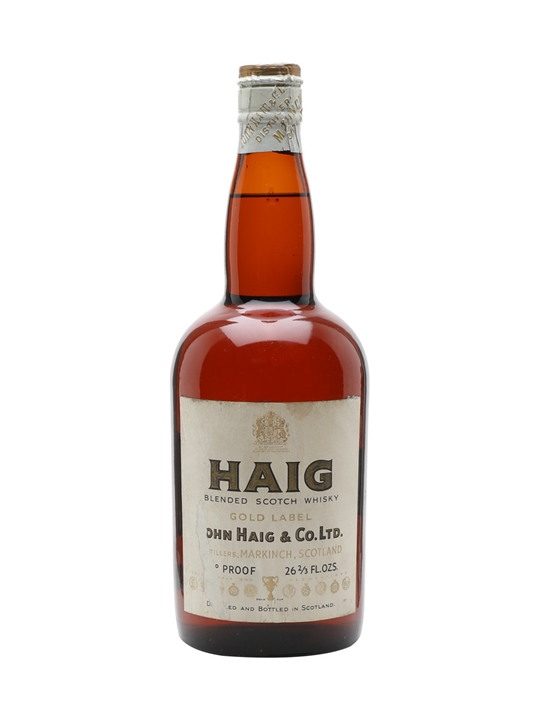

There's something sobering about holding a bottle that left a production line before you were born. This 1960s bottling of Haig Gold Label, complete with its original spring cap closure, isn't just a blended Scotch — it's a dispatch from the era when Haig was arguably the most recognised whisky brand on the planet. Before Johnnie Walker's marketing machine truly conquered every duty-free shelf, Haig was the name in blended Scotch. And at £199, you're paying as much for that history as you are for the liquid.
Let me be clear about what this is. Haig Gold Label was never positioned as a premium, age-statement whisky. It was the reliable, well-constructed everyday blend — the kind of bottle that sat on every drinks trolley in every middle-class British home through the 1950s and 60s. The Gold Label sat above the basic Haig but below the Dimple (or Pinch, if you were buying it stateside). It was assembled to be smooth, approachable, and consistent, and the blenders at Markinch knew exactly what they were doing.
What makes a bottle like this worth your attention in 2026 is context. The grain and malt whisky inside this bottle was distilled and blended at a time when production methods, yeast strains, and cask sourcing were fundamentally different from today. The grain component would have come from Cameronbridge, and the malt contributors would have included whiskies we simply cannot access anymore. That's not nostalgia talking — it's industrial reality. Distilleries have closed, processes have changed, and the flavour profiles of the 1950s and early 60s are genuinely distinct from what's produced now.
Tasting Notes
I'll be honest — with a bottle of this age and provenance, tasting notes deserve to come from your own experience rather than my dictation. Fill level, storage conditions, and the integrity of that spring cap closure all play a role in how this has evolved over six decades. What I can say is that well-stored Haig Gold Label from this period typically delivers a profile that modern blends rarely attempt: richer grain character, a certain waxy depth, and a style of blending that prioritised texture alongside lightness. Expect something noticeably different from any contemporary blend on your shelf.
The Verdict
At £199, this sits in a strange but increasingly crowded space — vintage blends priced as collectibles. Is it worth it? I think so, and here's why. You're not just buying a drink; you're buying access to a flavour era that's gone. The Haig name carried genuine weight in mid-century Scotch, and the blending team had access to components we can only read about now. The spring cap closure is a nice authentication detail — it dates the bottle cleanly to the early-to-mid 1960s, before screw caps became standard. For anyone interested in the history of blended Scotch, or for someone who wants to taste what their grandfather actually drank rather than just hearing the stories, this is a legitimate purchase. It's not a shelf trophy — it's a conversation in a glass. I'm giving it an 8.3 out of 10, weighted heavily by its historical significance and the genuine rarity of what's inside.
Best Served
Do not overthink this. A small measure, neat, at room temperature. Give it ten minutes in the glass before you go near it — the liquid has been sealed for sixty years and deserves a moment to breathe. If you find it opens up well, a few drops of water won't hurt, but start without. This is a whisky you taste slowly, paying attention. Save the ice for something that was bottled this decade.