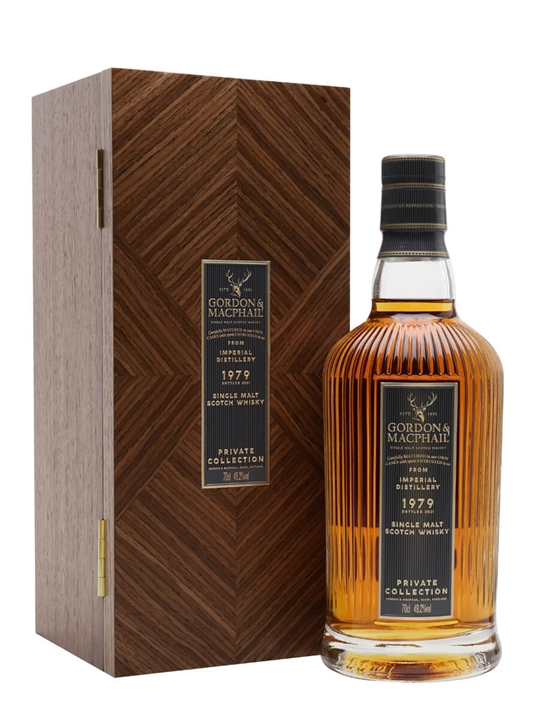

There are bottles that sit on a shelf and bottles that stop you in your tracks. The Imperial 1979, bottled by Gordon & MacPhail as part of their Private Collection, is firmly in the latter camp. A 42-year-old single malt from a distillery that no longer exists, drawn from Speyside at a time when the region's output was feeding blends rather than commanding four-figure price tags on its own merit. That this cask survived at all is remarkable. That it was in G&M's hands — a firm whose patience with long-aged stock is unmatched in the industry — feels almost inevitable.
Imperial closed its doors for the final time in 1998, and the buildings were largely demolished by 2013. What remains are the casks, scattered across independent warehouses, each one a diminishing piece of Speyside history. Gordon & MacPhail have long been the most reliable custodians of such stock, and their Private Collection tier signals something they consider genuinely exceptional. At 49.2% ABV after four decades in oak, this bottling has retained a surprising degree of strength — a sign that the cask was well-chosen and the warehousing conditions were kind to it over those long years.
A 42-year-old Speyside single malt at natural strength invites certain expectations. At this age, you are looking for the interplay between the spirit's original character and decades of oak influence. Imperial was never a heavily peated distillery; its spirit was typically light and grassy in youth, which means extended maturation tends to build layers of dried fruit, polished wood, and that particular waxy complexity that marks truly old Speyside malt. The 49.2% ABV suggests there is still real vitality here — this has not faded into a thin, over-oaked shadow of itself.
Tasting Notes
I have not published detailed tasting notes for this bottling at this time. When a whisky of this age and rarity crosses my desk, I prefer to revisit it across several sessions before committing specific descriptors to print. What I will say is that the style is unmistakably old Speyside — there is a depth and composure to it that younger malts simply cannot replicate, regardless of how good they are.
The Verdict
At £3,000, this is not an impulse purchase. But context matters. You are buying a 42-year-old single malt from a demolished distillery, bottled by the most respected independent in Scotland, at a strength that suggests genuine quality rather than mere survival. Comparable bottles from lost distilleries — Port Ellen, Brora, Rosebank before its revival — routinely command similar or higher prices, and Imperial's stock is only getting scarcer. For collectors with an interest in Speyside history, this is a serious bottle. For drinkers who appreciate what four decades of careful maturation can achieve, it delivers. I am scoring this 8.5 out of 10 — a reflection of both the whisky's inherent quality at this age and ABV, and the reality that Imperial at this level of maturity is something we will see less and less of as the years pass.
Best Served
Neat, in a tulip-shaped nosing glass, at room temperature. If you have spent £3,000 on a bottle, you owe it to yourself to experience it without interference. After your first pour, try adding three or four drops of still water — at 49.2%, there may be layers that open up with gentle dilution. Give it time in the glass. A whisky that has waited 42 years deserves at least twenty minutes of yours.