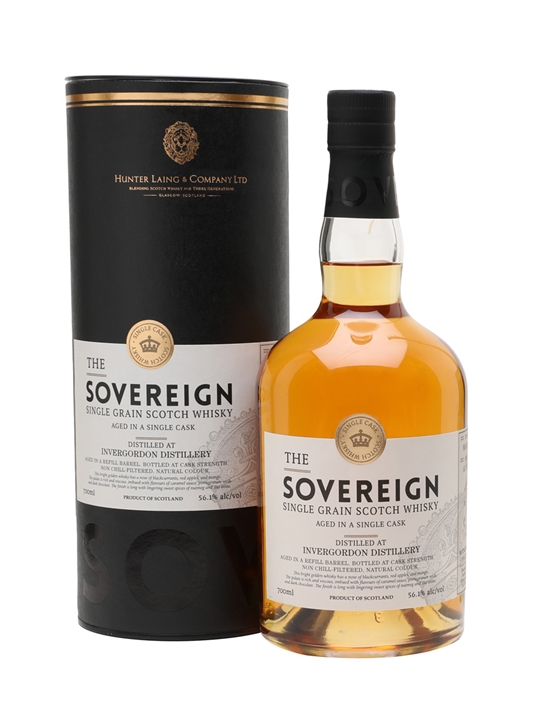

Single grain Scotch remains one of the category's best-kept secrets, and bottles like this Invergordon 1991 are exactly why. At 34 years old and bottled at a punchy 56.1% ABV as part of Hunter Laing's Sovereign range, this is the kind of independently bottled grain whisky that makes you wonder why the big blending houses get all the attention.
Invergordon, situated in the Highland town of the same name on the Cromarty Firth, is one of Scotland's largest grain distilleries — and most of its output disappears quietly into blends. That's the fate of grain whisky in general: it does the heavy lifting so the malts can take the credit. But give a grain whisky three decades in a single cask and something genuinely interesting happens. The extended maturation transforms what starts as a lighter, more neutral spirit into something with real depth and character. A 1991 vintage means this was distilled in a very different era for Scotch production, and the intervening years have done their work.
At 56.1%, this hasn't been watered down to hit some arbitrary number — it's been bottled at whatever strength the cask delivered after 34 years, which tells you Hunter Laing trusted the liquid to speak for itself. That's a good sign. The Sovereign series has built a solid reputation for selecting individual casks that show a distillery's character at its most distinctive, and the decision to release this at cask strength suggests genuine confidence in what's inside the bottle.
What to Expect
Aged single grain Scotch in this range tends to develop a profile quite distinct from malt whisky. You're typically looking at rich, dessert-like qualities — think toffee, vanilla, tropical fruit, and oak spice — with that characteristic grain smoothness underneath. The high ABV means there's likely plenty of intensity here, and a few drops of water should open it up considerably. Don't be fooled by the 'grain' label into expecting something thin or simple. At this age, grain whisky can rival many single malts for complexity.
The Verdict
At £131 for a 34-year-old Scotch whisky at cask strength, this represents genuinely good value. Try finding a 34-year-old single malt at that price — you'll be looking at three or four times the cost, minimum. That value equation is part of grain whisky's appeal, but it shouldn't be the whole story. This deserves attention on its own merits: a well-aged, cask-strength expression from a distillery whose output rarely gets to shine in its own right. I'm giving it 8.2 out of 10 — a whisky that rewards patience and curiosity, and one that might convert a few grain sceptics along the way.
Best Served
Pour it neat first and sit with it for a few minutes — at 56.1%, it needs time to breathe. Then add water gradually, a few drops at a time, until it hits the sweet spot. This is an after-dinner whisky, full stop. It has the richness and complexity to stand alongside a good dessert or replace one entirely. If you're sharing it with someone who claims they don't like grain whisky, all the better.